Theresienwiese, Square for public events in Ludwigsvorstadt-Isarvorstadt, Germany
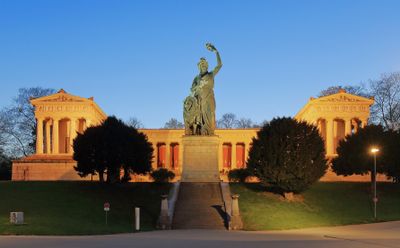
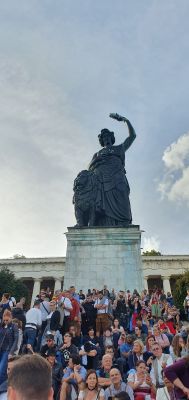
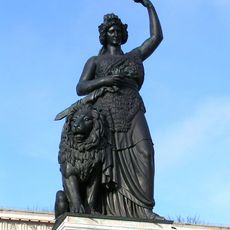
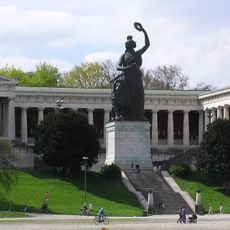
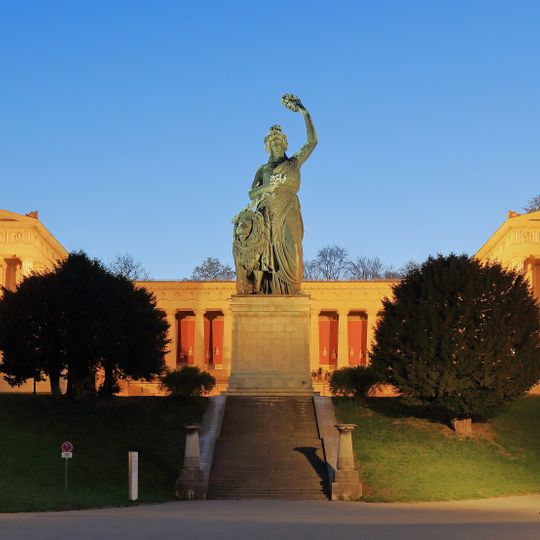
Theresienwiese is a 42-hectare open ground of grey gravel and packed earth, crossed west to east by the pedestrian and cyclist Matthias-Pschorr-Straße. At its western end stands the Bavaria statue, a robed woman holding a wreath above her head with a lion beside her, on a light tan stone pedestal before the Ruhmeshalle. The 97-metre neo-Gothic tower of St. Paul's Church rises to the north.
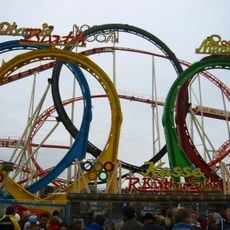
On 12 October 1810 Crown Prince Ludwig married Princess Therese of Saxe-Hildburghausen; the celebrations ended on 17 October with a horse race organised by banker Andreas Michael Dall'Armi, won by coachman Franz Baumgartner before 50,000 spectators on the slope. The race was repeated in 1811, starting the Oktoberfest tradition, and a first agricultural fair was added that same year. In 1818 the first carousels and swings appeared, and from 1896 came the first large beer tents.
The name honours Princess Therese of Saxe-Hildburghausen, whose 1810 wedding to Crown Prince Ludwig was followed by a horse race organised by banker Andreas Michael Dall'Armi. Locals call the ground die Wiesn. Since 2010 the Oide Wiesn has run alongside the Oktoberfest, reviving traditional rides and brass-band tents.
The area is easily accessible via U-Bahn lines U4 and U5, with additional access from S-Bahn stations at Hauptbahnhof and Hackerbrücke. The terrain is relatively flat and open, making navigation straightforward whether visiting during quiet times or when events are underway.
The 42-hectare gravel surface is not green: the name "meadow" survives only in memory, and in dry periods spontaneous ruderal plants colonise parts of the gravel, so patches of the grounds can genuinely be read as meadow. The 97-metre neo-Gothic tower of St. Paul's Church rises to the north.
The community of curious travelers
AroundUs brings together thousands of curated places, local tips, and hidden gems, enriched daily by 92,862 contributors worldwide.