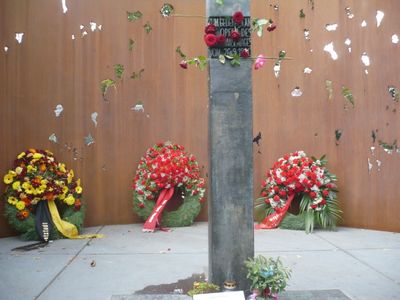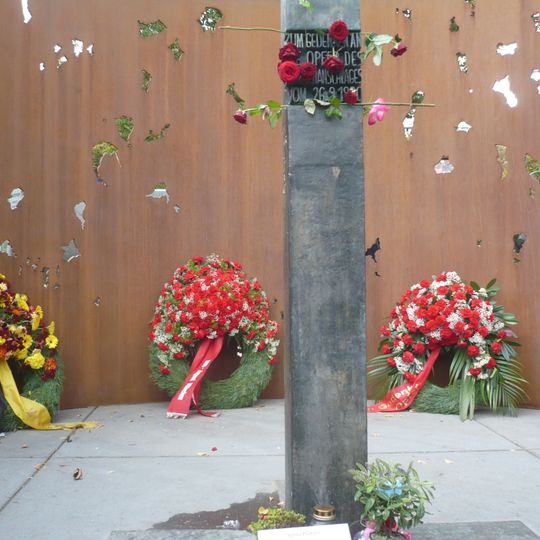
Denkmal für die Wiesn-Attentat-Opfer, Memorial monument at Theresienwiese entry, Munich, Germany.
The Denkmal für die Wiesn-Attentat-Opfer stands at the northern edge of Theresienwiese in Munich, near the Oktoberfest main entrance. It consists of a bronze stele set in the centre of a circle 6.10 metres in diameter inscribed in the pavement, backed by a semicircular steel wall 2.70 metres high whose perforations evoke the injuries caused by the attack.
The memorial commemorates the victims of the bomb attack at the Oktoberfest on 26 September 1980, in which twelve people died and the attacker also lost his life. Created by sculptor Friedrich Koller, it was handed over to the public on 18 September 1981, the first anniversary of the attack. In 1987, at the request of the bereaved, the names of the twelve victims were engraved on the bronze stele. The site was redesigned in 2008.
The bronze stele bears the names of the twelve victims, engraved in 1987 at the request of their relatives. The attacker, Gundolf Köhler, who died in the explosion, is not named. The memorial is a place of remembrance for the families and for visitors to the Oktoberfest.
The memorial stands at the northern edge of Theresienwiese, right by the main entrance of the Oktoberfest grounds. The bronze stele sits in the centre of a circle 6.10 metres across, set into the paving, with the 2.70-metre semicircular steel wall behind it. During the Oktoberfest the site is crowded and partly blocked by the fairground; outside the festival weeks it can be viewed without obstruction.
A circle approximately 6.10 meters in diameter is marked in the pavement and indicates the exact spot where the explosion occurred. This subtle marking makes the location of the disaster tangible to visitors and connects the past with the present space.
The community of curious travelers
AroundUs brings together thousands of curated places, local tips, and hidden gems, enriched daily by 92,634 contributors worldwide.