Effelsberg 100-m Radio Telescope, Radio telescope in Bad Münstereifel, Germany.
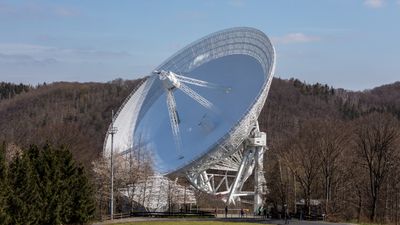
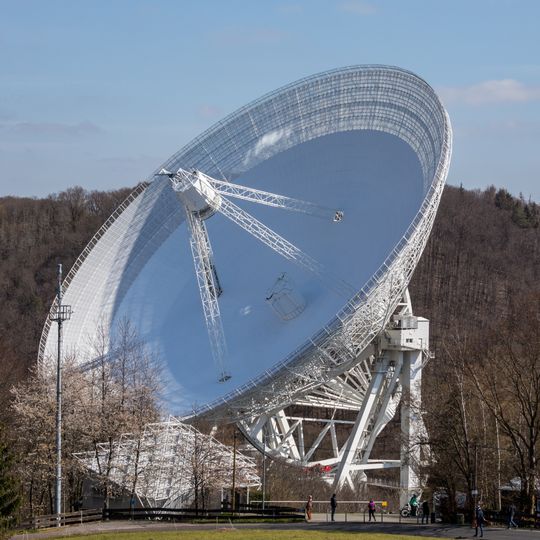
The Effelsberg 100-m Radio Telescope is a fully steerable parabolic dish in Bad Münstereifel. Its light-blue concave surface is surrounded by a white lattice rim, with four lattice struts meeting at a focus above the dish. The structure rests on a white cylindrical tower topped by a small cabin, and the dish can tilt to nearly 90 degrees.
After opening in 1972, this facility remained the largest fully steerable radio telescope in the world for nearly three decades. It was built by the Max Planck Institute for Radio Astronomy in Bonn and continues to operate under the same institution.
The telescope is named after the Effelsberg district of Bad Münstereifel, about 1.3 km to the southwest. A hiking path passes the dish, and in 2004 part of it became a planet trail with information panels on the Solar System, ending at a 39 cm model of the Sun beside the visitor centre. The dish also appeared on a 500-pf stamp of the Deutsche Bundespost.
A hiking path leads past the telescope; in 2004 part of it became a planet trail with information panels on the Solar System, ending at a 39 cm model of the Sun beside the visitor centre. The telescope stands on a paved area at 319 m elevation, with the Effelsberger Bach and the state border 74 m to the east.
The entire mirror support structure was designed by computer so that the parabolic shape remains perfect at all observation angles, even though the weight of the construction acts differently depending on its position. This technique was new at the time of construction and made it possible to build a much larger moving telescope.
The community of curious travelers
AroundUs brings together thousands of curated places, local tips, and hidden gems, enriched daily by 94,173 contributors worldwide.