Haus der Kunst, Art museum in central Munich, Germany
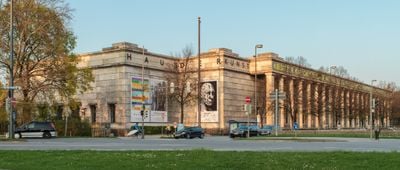
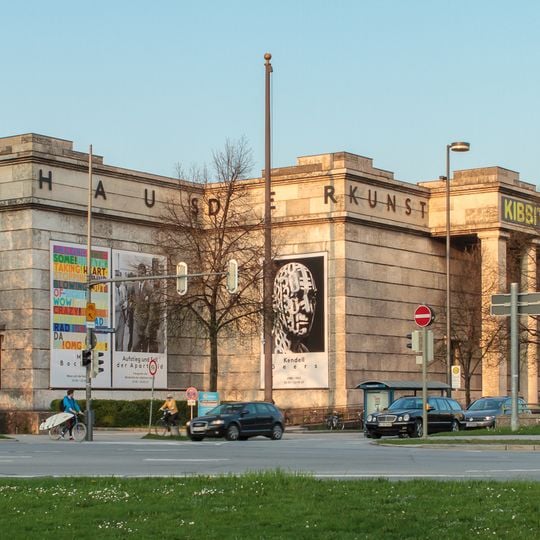
Haus der Kunst is a 175-metre-long exhibition building on Prinzregentenstraße, its light tan facade of large limestone blocks from the Danube valley near Kelheim broken by projecting bays and a 21-axis portico of colossal, non-fluted columns. Dark metal letters spell "HAUS DER KUNST" along the top frieze. The steel-frame structure is clad in stone slabs, and the base is faced with Nagelfluh conglomerate.
Adolf Hitler ordered the building in 1933 as the Haus der Deutschen Kunst, with plans by Paul Ludwig Troost; the foundation stone was laid in October 1933 and the house opened in 1937. It was the first major architectural project commissioned by the Nazis, and the opening was staged with the Day of German Art parade of 6,000 participants. After 1945 the US Army used it as an officers' mess, and from 1946 its rooms served as temporary exhibition space.
The Golden Bar at the east end of the North Gallery occupies the former artists' festival room; Karl Heinz Dallinger's wall paintings, uncovered by 2004, show maps and exotic motifs on the origins of alcoholic drinks and stimulants against a gold-leaf background. In the basement of the west wing, the nightclub P1 has used the former beer parlour since 1983, and its rent is one of the museum's revenue streams.
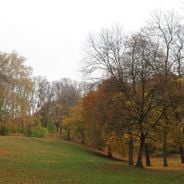
The museum is located next to the English Garden and easily accessible by public transportation. Plan enough time for the current exhibition, as the spaces are generously scaled.
The air-raid shelter built into the Haus der Kunst has served as an exhibition space since 2011. It is separate from the Goetz Collection, whose video works came to Bavaria in 2013 as a permanent loan of almost 5,000 pieces; the two are not linked. Look for the entrance in the lower level, reachable at ground level at the rear because the terrain drops away.
The community of curious travelers
AroundUs brings together thousands of curated places, local tips, and hidden gems, enriched daily by 94,061 contributors worldwide.