Prinz-Carl-Palais, City palace in Old Town, Munich, Germany
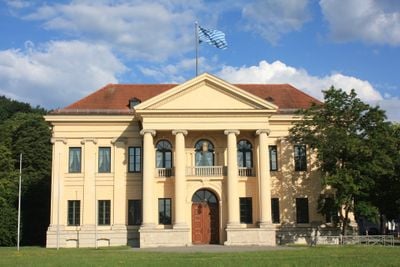
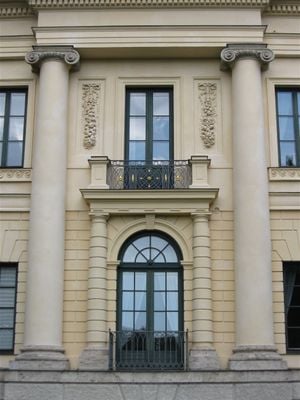
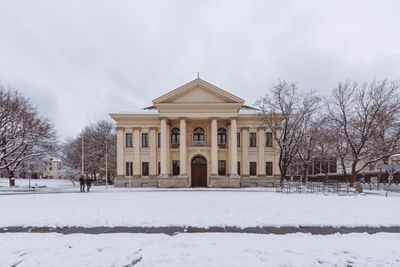
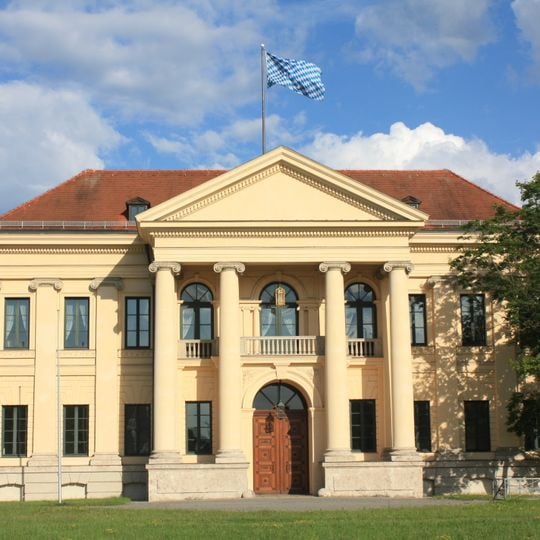
The Prinz-Carl-Palais is an early Neoclassical mansion built in 1804–1806 to plans by Karl von Fischer. Its two-storey pale yellow facade has a red tiled roof, a triangular pediment with dentils above four tall columns, and a round-arched wooden double door with a fanlight beneath a stone balustraded balcony. A projecting south avant-corps faces a garden; lion sculptures mark the entrance.
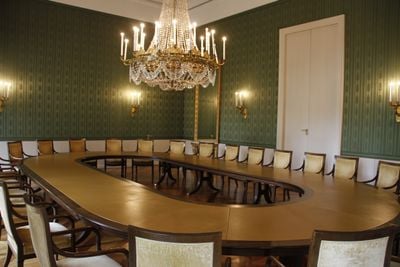
Karl von Fischer planned the mansion in 1803 for Abbé Pierre de Salabert, a former teacher of King Maximilian I Joseph, and it was built in 1804–1806. After Salabert died in 1807 the king bought it; in 1825 his son Ludwig I gave it to his brother Prince Carl, who had Jean-Baptiste Métevier and Anton Schwanthaler decorate the rooms. From 1876 it housed the Austria-Hungary diplomatic mission, and in 1924 it became the residence of Bavaria's prime ministers.
The name recalls Prince Carl, brother of King Ludwig I, who received the building in 1825 and had its rooms decorated by Jean-Baptiste Métevier and Anton Schwanthaler. Since 1924 it has served as the residence of Bavaria's prime ministers, a role it still holds.
The palace is easy to find in the Old Town and can be viewed from outside at any time. It is not regularly open to visitors, so it is worth checking in advance whether guided tours or open days are available.
From 1876 the palace housed the Austro-Hungarian diplomatic mission, not in the mid-19th century. In 1924 it became the residence of Bavaria's prime ministers. The two-storey building ends in a roof balustrade above a raised rustic basement, and lion sculptures at the entrance were chosen to represent the Bavarian crown.
The community of curious travelers
AroundUs brings together thousands of curated places, local tips, and hidden gems, enriched daily by 93,055 contributors worldwide.