Augusteum, Art museum in Oldenburg, Germany.
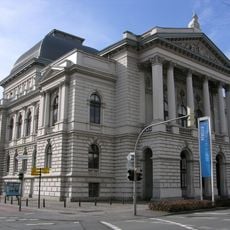
The Augusteum is a two-storey brick museum building at Elisabethstraße 1, south of Oldenburg Castle, completed in 1867. Seven bays wide on a cellar base, it has a hipped roof and a central portal framed by paired Corinthian columns on pedestals, with the inscription "AUGUSTEUM" above. Two seated allegorical figures of painting and sculpture by Diedrich Samuel Kropp crown the facade.
The Augusteum was built from 1865 to 1867 south of Oldenburg Castle on the Mühlenhunte, the former castle moat, and completed as one of the first public museum buildings in northern Germany. Grand Duke Nikolaus Friedrich Peter funded it and named it after his father, Grand Duke Paul Friedrich August. Its collection began in 1804, when Duke Peter Friedrich Ludwig bought 86 paintings from the private collection of Johann Heinrich Wilhelm Tischbein. In 1908 Karl Schmidt-Rottluff and Erich Heckel held their first joint exhibition here.
The museum is named after Grand Duke Paul Friedrich August (1783–1853), father of the founder, Peter II. The building also housed the Oldenburg Art Association, founded in 1843, and in 1908 the Expressionists Karl Schmidt-Rottluff and Erich Heckel held their first joint exhibition here.
The Augusteum stands at Elisabethstraße 1, south of Oldenburg Castle on the former Mühlenhunte, now called Schlossgraben. The Prinzenpalais, Elisabeth-Anna-Palais and the northeast corner of the Schlossgarten are within walking distance. The galleries occupy two floors reached by the painted staircase, so allow time for the stairs.
Until 1875 a balustrade with 19 putti carrying festoons crowned the cornice; it was later removed. The portal is framed by paired Corinthian columns on pedestals, and above the inscription "AUGUSTEUM" sit two allegorical figures of painting and sculpture carved by Diedrich Samuel Kropp.
The community of curious travelers
AroundUs brings together thousands of curated places, local tips, and hidden gems, enriched daily by 93,099 contributors worldwide.