Belvedere, Historical pavilion in Charlottenburg Palace Gardens, Germany
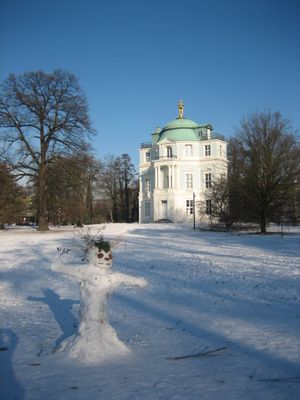
The Belvedere is a three-storey pavilion in the northeastern part of Charlottenburg Palace Park, built in the transition from Baroque to Neoclassical style. Its plan is an oval with four rectangular projections: entrances on the ground floor, columns on the east and west sides, pilasters on the north and south, and balconies above. A copper-clad dome carries three gilded youths holding flower baskets, a free repetition by Karl Bobek of Johann Eckstein's original group.
Carl Gotthard Langhans designed the three-storey pavilion, built in 1788–89 for King Friedrich Wilhelm II in the transition from Baroque to Neoclassical style. It was first erected on an island in the palace park. Badly damaged in 1943, it was rebuilt between 1956 and 1960 using old engravings, though the interiors of its three stacked halls were not restored to their original state.
The structure houses Berlin's porcelain collection with dinner services and vases from royal workshops. The exhibition reflects how kings and nobles valued fine ceramics as symbols of wealth and refinement.
The pavilion sits in the Charlottenburg Palace gardens and is best reached through the main garden entrances. Muddy or wet paths are common during rainy seasons, so sturdy shoes are recommended for comfortable walking.
The pavilion hosted secret gatherings of a mystical order that practiced spiritualism and held sway over the king's beliefs. This hidden chapter remains one of the lesser-known aspects of the palace's complex past.
The community of curious travelers
AroundUs brings together thousands of curated places, local tips, and hidden gems, enriched daily by 92,901 contributors worldwide.