Bennohöhle, Natural cave in Rosenthal-Bielatal, Germany.
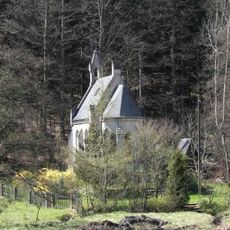
Bennohöhle is a fissure cave in the Bielatal, formed by blocks of sandstone debris on the left bank of the Biela south of the Ottomühle. It runs about 35 metres long and reaches 13.5 metres deep, with a rear wall bearing a carved inscription and a chalice. Since around 1850 the entrance has been hewn artificially out of the rock.
The cave was opened to visitors in 1824 by forester Puttrich of Rosenthal and the owners of the Ottomühle and Wormsmühle mills, aiming to attract walkers exploring the Bielatal. Carl Merkel first described it in 1825. The inscription and carved chalice on the rear wall are a modern forgery by the cave's developers, exposed by the modern form of the digit 4.
The cave's name recalls a supposed hermit Benno, said to have lived and died here as a persecuted Hussite; Carl Merkel recorded this guess in 1825. A chalice carved beside the inscription was linked to his burial. Other legends tell of an Italian gold and gemstone seeker who buried his finds here.
A visit requires a flashlight and sturdy footwear, as the path is uneven and can be slippery in places. The cave sits on the left bank of the Biela River and is accessible on foot from the valley below.
The inscription on the rear wall, long read as a medieval mark, is a modern forgery: the numeral 4 is written in its modern form. Carl Merkel had linked it in 1825 to Burgrave Otto Maul von Dohna, hiding in 1401 during the Dohna Feud, and to a Hussite hermit named Benno; the cave's name comes from that legend.
The community of curious travelers
AroundUs brings together thousands of curated places, local tips, and hidden gems, enriched daily by 94,411 contributors worldwide.