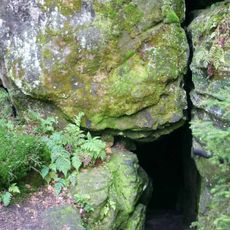
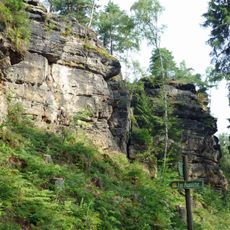
Herkulessäulen, Rock formations in Sächsische Schweiz-Osterzgebirge, Germany.
The Herkulessäulen are two slender sandstone towers rising from a shared rock base and distinguished by their differing heights. They form a striking climbing destination with numerous routes of varying difficulty and rank among the notable rock formations in the Bielatal valley.
Carl Merkel, a private scholar, gave the two towers their names in his 1826 work on the western Saxon-Bohemian Switzerland, borrowing from the ancient Pillars of Hercules. Most of his many rock names in the Bielatal did not endure, but this one did. The Great Pillar was first climbed in 1904 by Rudolf Nake, F. Goldberger and A. Kliche; the Little Pillar a year later by Hanns Schueller and Oliver Perry-Smith.
Carl Merkel named the towers in 1826 after the Pillars of Hercules, the mountains flanking the Strait of Gibraltar in classical myth. Most of his imaginative names for Bielatal rocks did not endure, but this one did. Nearby climbing peaks later took derived names: Herkuleskopf, Herkulessohn and Herkuleswand.
These rock towers offer climbing routes for different skill levels and require appropriate equipment and experience. The best access is through the Bielatal valley and visitors should check conditions on site since weather can affect accessibility.
Both towers are about 20 metres tall, but the Little Herkules Pillar stands on a rock base whose valley face rises some 35 metres. The overhanging summit heads come from a particularly erosion-resistant layer within the Labiatussandstein of the Schmilka Formation, the oldest sandstone of the Cretaceous Elbe Sandstone Mountains. New routes are banned on both summits.
The community of curious travelers
AroundUs brings together thousands of curated places, local tips, and hidden gems, enriched daily by 94,471 contributors worldwide.