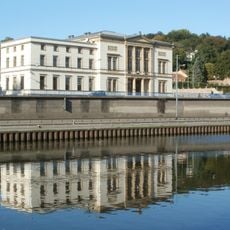
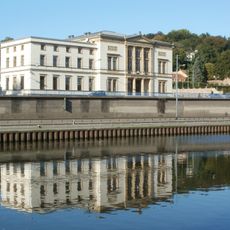
Saarland Museum, Art museum in Saarbrücken, Germany
The Saarland Museum is an art institution in Saarbrücken housing paintings and sculptures across multiple buildings and levels. Its collection spans from medieval times to modern art, emphasizing German and French artistic traditions.
The museum grew out of the Staatliches Museum Saarbrücken, which built a major modern art collection during the Weimar Republic. In 1937 the Nazis seized a large number of these works in the "Entartete Kunst" campaign, and many were destroyed. Rudolf Bornschein, first director of the Modern Gallery, assembled its Expressionist holdings. The fourth pavilion of the Modern Gallery, planned for decades, opened in 2017 after Kuehn Malvezzi took over the project.
The museum's three sites each have a different focus: the Palace Church shows religious art from the Middle Ages to the 19th century, the Old Collection covers the 16th to 19th centuries, and the Modern Gallery presents art from the 19th century to the present. The Palace Church also serves as a performance venue for the Saar University of Music and has hosted contemporary art exhibitions since 2012.
The three sites are separate: the Old Collection sits in the Kreisständehaus beside Saarbrücken Palace, the Museum in the Palace Church occupies the Schlosskirche, and the Modern Gallery stands across the Saar near the State Theatre. A glass tract added in 2004 on the south side of the choir links the Palace Church to the Old Collection. The sculpture garden lies south of the Modern Gallery above the Willi-Graf-Ufer.
The sculpture garden was laid out south of the Modern Gallery above the Willi-Graf-Ufer as early as the 1960s, making it older than the gallery's fourth pavilion, which only opened in 2017 after a scandal-ridden construction phase.
The community of curious travelers
AroundUs brings together thousands of curated places, local tips, and hidden gems, enriched daily by 92,895 contributors worldwide.