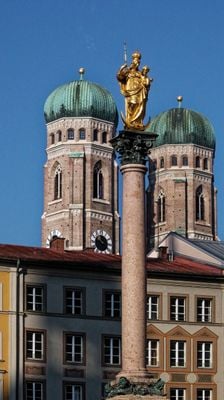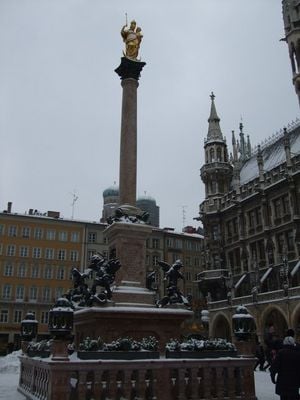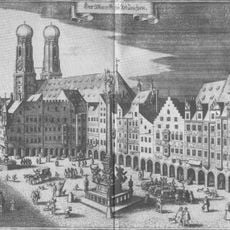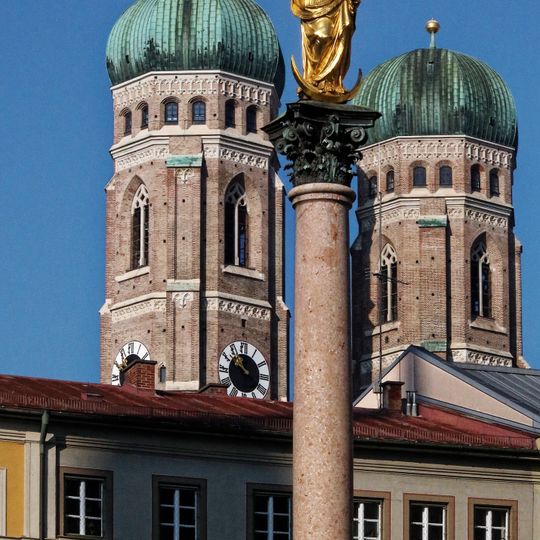
Mariensäule, Marian column in Marienplatz, Munich, Germany.
The Mariensäule is a column of reddish Adnet marble on Marienplatz, crowned by a gilded bronze figure of Mary standing on a crescent moon, holding the Christ Child and a sceptre. At the corners of its pedestal stand four bronze putti fighting a lion, a basilisk, a dragon and a serpent.
Maximilian I vowed in the Thirty Years' War to erect a godly work if Munich and Landshut were spared. Munich was occupied by Swedish troops and its army command demanded its destruction, but King Gustav II Adolf decided against it. The column was erected in 1638 from Adneter marble and consecrated on 7 November 1638 by Bishop Veit Adam von Gepeckh.
The four bronze figures at the pedestal corners are putti, not angels: they fight the lion (war), basilisk (plague), dragon (famine) and serpent (unbelief), illustrating Psalm 91:13. Their shields carry the verse in shortened form. The putti were modelled by an unnamed "Master of the Heroic Putti" and cast by Bernhard Ernst; the 1990s replacements are copies.
The column stands in the open on Marienplatz, so it can be walked around at any hour; the pedestal and bronze putti are at eye level, while the gilded figure is best seen from a few steps back. Distance signs pointing to Munich measure their kilometres to this column, the former zero point of the country's roads.
The gilded statue of Mary on top originally dates from 1593 and was first intended for Duke Wilhelm V's tomb before finding its place here. This reuse shows how artworks changed their purpose and location over time.
The community of curious travelers
AroundUs brings together thousands of curated places, local tips, and hidden gems, enriched daily by 94,232 contributors worldwide.