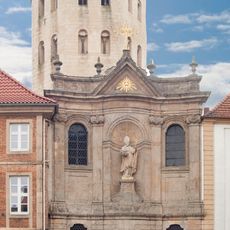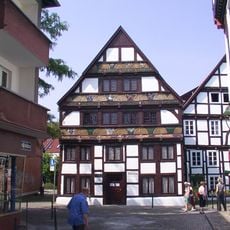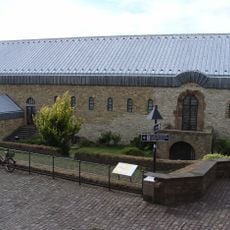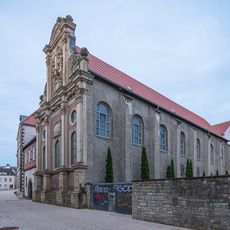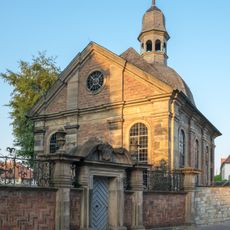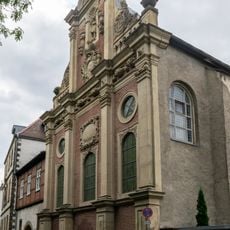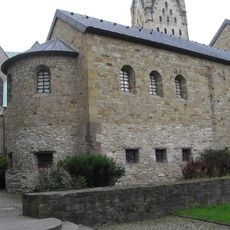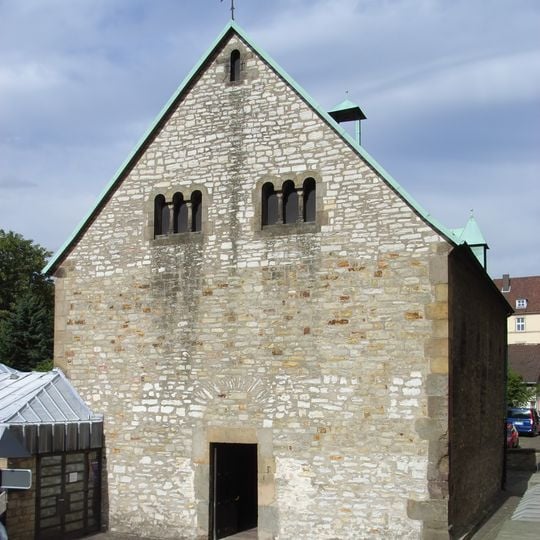
Saint Bartholomew's Chapel, Romanesque chapel in Paderborn, Germany.
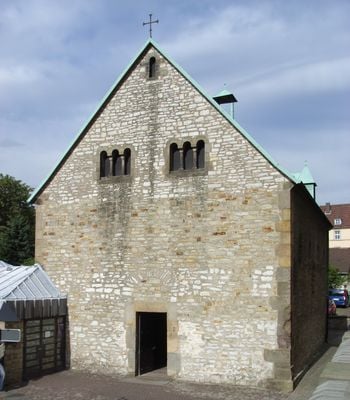
Saint Bartholomew's Chapel is a stone chapel built around 1017 north of Paderborn Cathedral. Its steep gabled facade of rough light stones has two round-arched windows divided by small columns and a round-arched doorway with a dark double door. Inside, Byzantine builders set domed vaults on columns whose capitals are key works of Ottonian sculpture.
Bishop Meinwerk of Paderborn (1009–1036) had the chapel built around 1017 as part of the Ottonian royal palace he erected for Henry II, and the 12th-century Vita Meinwerci states that Greek builders raised it. Excavations show it was integrated into that palace. Its purpose is uncertain; Manfred Balzer suggests it served the king's liturgical vesting before he entered the cathedral. Renovated in 1825–1828 under Frederick William III, it survived the Second World War with minor damage.
The chapel's name comes from the apostle Bartholomew, to whom it is dedicated. From 1591 the Jesuits held the Bartholomew benefice, and after the order was dissolved in 1773 the Studienfonds took over its administration. In the 19th century a slater used the chapel as a workshop; from 1940 Polish forced labourers attended Sunday Mass here.
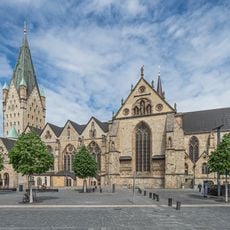
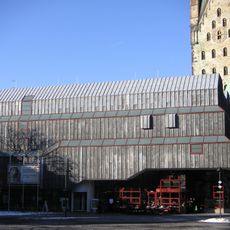
The chapel stands on the north side of Paderborn Cathedral, next to the Museum in der Kaiserpfalz, in the pedestrian old town. The entrance is the bronze door made by Heinrich Gerhard Bücker in 1978. The interior is small and the floor uneven in places, so allow a short visit rather than a long one.
The chapel's dimensions match exactly those of the Myrelaion Church in Constantinople, built before 922 by Emperor Romanos I as his palace chapel. Its hanging domes, however, have no direct Byzantine model; comparable domes appear in the cistern beneath the neighbouring palace.
The community of curious travelers
AroundUs brings together thousands of curated places, local tips, and hidden gems, enriched daily by 92,862 contributors worldwide.