Quedlinburg Abbey, Former secular canonesses' abbey in Quedlinburg, Saxony-Anhalt, Germany
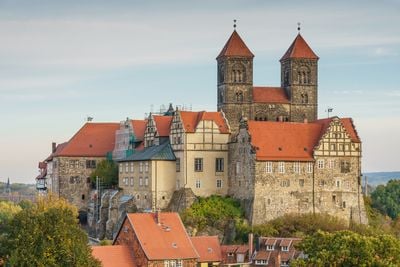
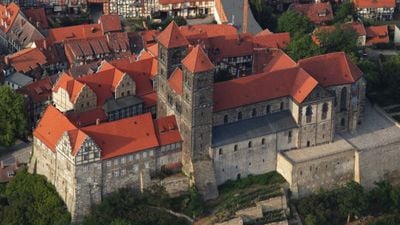
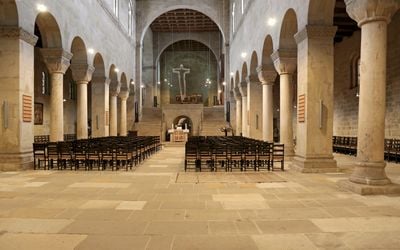
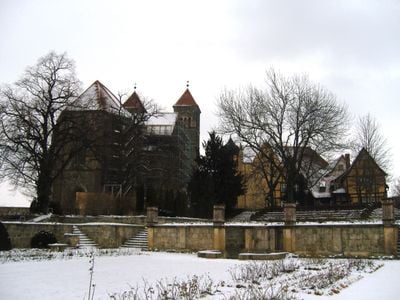
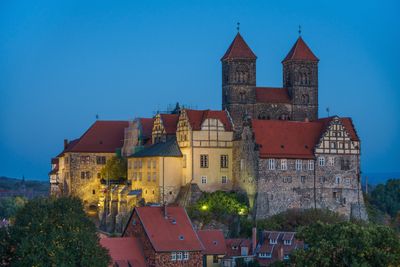
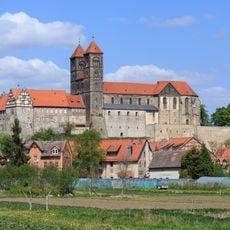
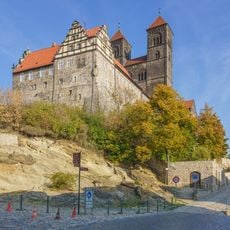
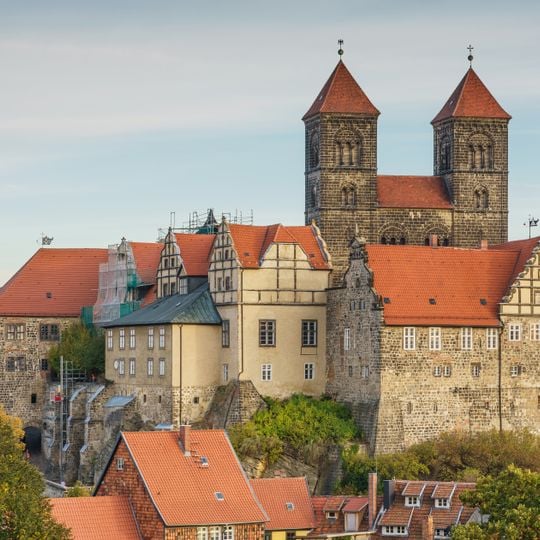
Quedlinburg Abbey is a former secular canonesses' foundation on the castle hill of Quedlinburg. Its church, Stiftskirche St Servatius, is a Romanesque building with two square towers of rough dark masonry topped by steep red pyramidal roofs with crosses. Lower wings have cream walls and red tile roofs, and a half-timbered section with brown beams stands centrally.
Quedlinburg Abbey was founded in 936 by King Otto I at the request of his mother, Queen Mathilda, as a memorial to her husband, King Henry the Fowler, who was buried on the castle hill. It was a house of secular canonesses, not a monastery, and its abbesses held a seat at the Imperial Diet. Abbess Anna II of Stolberg led the house to the Reformation in 1539, and Prussia absorbed it in the secularisation of 1802/03.
The community was a secular canoness foundation, not a convent under monastic vows: its unmarried noblewomen followed the Aachen Rule of 816. The full title, "Kaiserlich freie weltliche Reichsstift Quedlinburg", was used until 1802. The abbess held a seat and vote at the Imperial Diet, and the church still holds the remains of Saint Mathilda and her granddaughter, Abbess Mathilda.
The monastery grounds are open to visitors and feature multiple buildings with exhibits about medieval monastic life and architectural heritage. The best time to visit is during daylight hours when you can explore the buildings thoroughly and notice the architectural details.
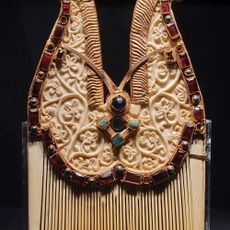
The abbess held a seat and vote at the Imperial Diet, sitting on the Bench of the Prelates of the Rhineland within the College of Ruling Princes. The community was a secular canoness foundation, not a monastery: its members followed the Aachen Rule of 816 and kept private means. The treasury once held the 9th-century Samuhel Evangeliary, stolen by an American soldier after World War II and returned in 1993.
The community of curious travelers
AroundUs brings together thousands of curated places, local tips, and hidden gems, enriched daily by 93,095 contributors worldwide.