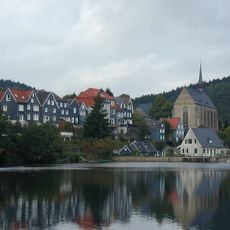
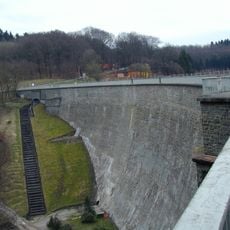
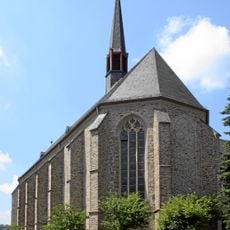
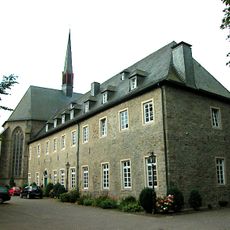
Beyenburger Brücke, Stone arch bridge in Langerfeld-Beyenburg and Schwelm, Germany.
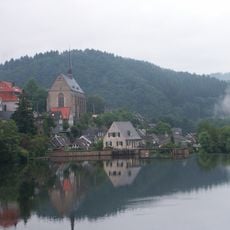
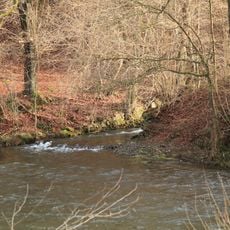
The Beyenburger Bridge is a stone arch bridge that crosses the Wupper River and connects areas of Wuppertal and Schwelm. It displays solid medieval construction with robust masonry and characteristic arches that remain largely unchanged.
The bridge is first documented in 1336, when it served as a vital point on the trade route running from Cologne through Dortmund to Soest. Over the centuries it remained an essential crossing whose importance continues to this day.
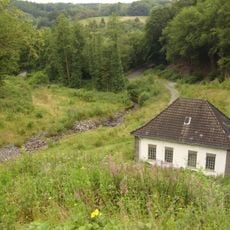
The Wupper here forms the boundary between the Rhineland and Westphalia, once dividing Franks and Saxons and later Berg and Electoral Cologne. The name Porta Westfalica, the gate to Westphalia, was transferred to the road cutting through a nearby ridge. In the Middle Ages only riders and pedestrians used the direct route over the ridge; carts took a gentler detour via Brambecke and Weuste, where hollow-way tracks are still visible in the woods.
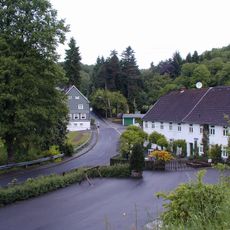
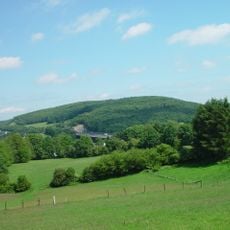
The bridge carries the Kurvenstraße (Landesstraße 411) over the Wupper; on the Schwelm side it meets the junction of Wupperstraße, Beyenburger Straße and Straße Porta Westfalica. The valley lies more than 100 metres below the surrounding ridges, so the approaches from north and south climb steeply and run in tight curves. Hollow-way traces of the medieval road survive in the woods south of the river and north of Weuste.
The name Porta Westfalica, meaning "gate to Westphalia", comes from the Wupper crossing itself: the Beyenburger Straße cuts through a low ridge near the bridge, and in the Middle Ages only riders and pedestrians used this direct route, while carts took a gentler detour via Brambecke and Weuste. Hollow-way traces from that old road are still visible in the woods north of Weuste.
The community of curious travelers
AroundUs brings together thousands of curated places, local tips, and hidden gems, enriched daily by 94,501 contributors worldwide.