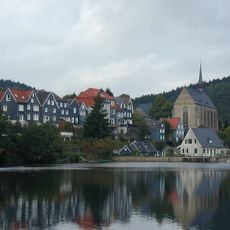
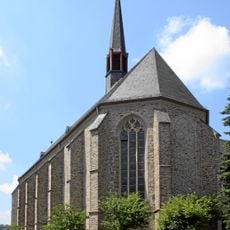
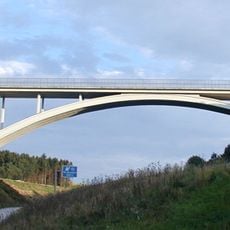
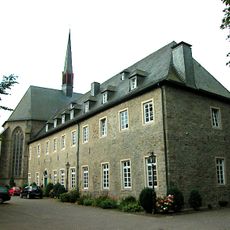
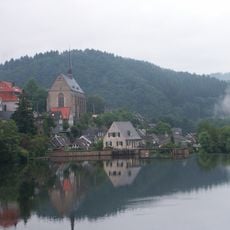
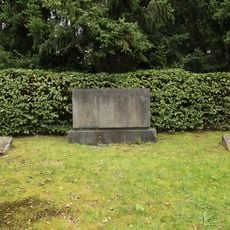
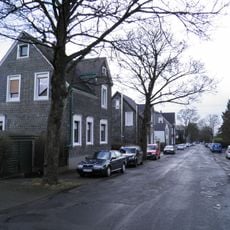
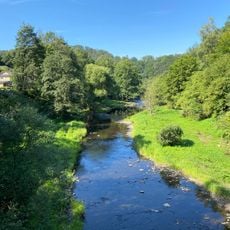
Herbringhauser Dam, Dam and architectural heritage monument in Wuppertal, Germany.
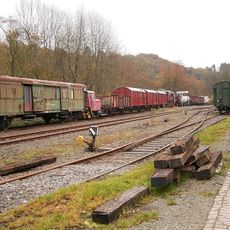
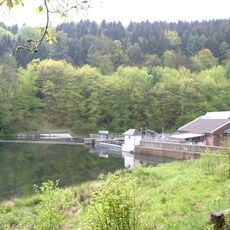
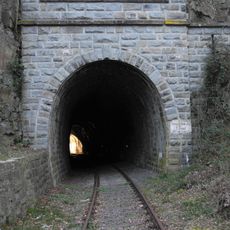
Herbringhauser Dam is a gravity dam of quarry-stone masonry built from 1898 to 1901 to plans by Otto Intze, holding back the Herbringhauser Bach in Wuppertal. The wall stands on slate bedrock; its stone came from the Zur guten Hoffnung quarry near Niederdahlhausen and was hauled along a 2450 m narrow-gauge railway. Since 2000–2003 the water side carries a plastic geomembrane sealing (Carpi system) over a sprayed-concrete shell, with an inspection gallery and drains.
The city of Barmen, now part of Wuppertal, built the dam between 1898 and 1901 to replace its insufficient drinking water supply from Ruhr bank filtrate. Barmen secretly bought 140 hectares in the Herbringhauser valley through Lüttringhausen mayor Richard Gertenbach, who negotiated an annual 100,000 m³ water share for his community from 1906. The dam was designed by Otto Intze and built by a Beyenburg contractor named Rothstein.
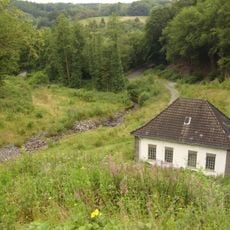
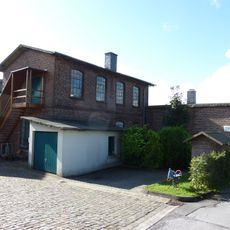
The dam was long called the Barmer Talsperre, after the city of Barmen that built it; the name changed to Herbringhauser Talsperre only after the lower basin was demolished in 2006. The nearby waterworks Herbringhausen still treats the reservoir's water, and the surviving pump house of the former lower dam is a protected monument.
The area around the dam is reachable on foot or by bicycle, with paths that also attract runners. The terrain is hilly, so solid footwear is a good idea, especially after rain when some stretches can become slippery.
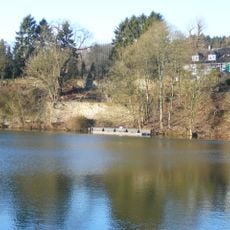
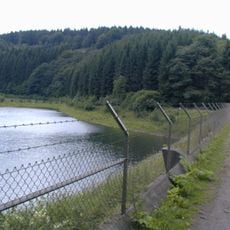
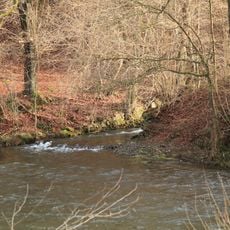
Although the dam sits within a densely populated part of the Bergisches Land, it remains almost hidden until you are right in front of it, tucked deep into a forested valley. Standing on the top of the dam wall gives a view of open water on one side and treetops on the other.
The community of curious travelers
AroundUs brings together thousands of curated places, local tips, and hidden gems, enriched daily by 94,457 contributors worldwide.