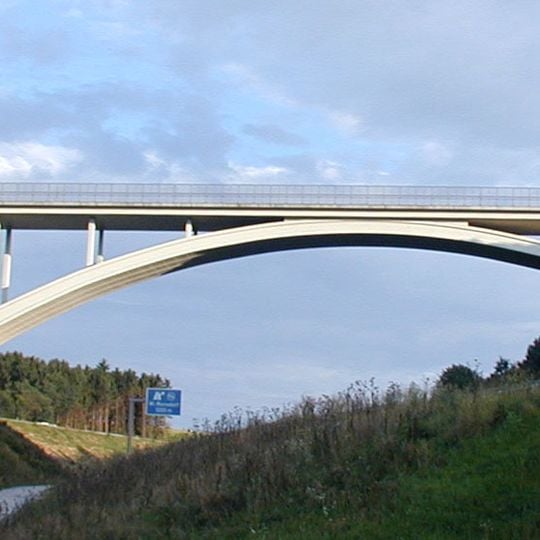
Blombachtalbrücke, Concrete arch bridge in Wuppertal, Germany.
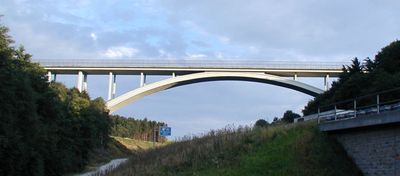
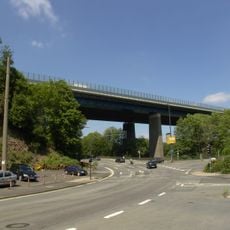
The Blombachtalbrücke is a concrete arch bridge that spans across the Blombach Valley in Wuppertal, carrying regional road traffic over an elevated section. The structure passes above a railway line and highway while connecting separate elevated zones of the city.
Built between 1957 and 1959 by Beton- und Monierbau to a design by Hellmut Homberg with Josef Pirlet and architect Gerd Lohmer, the bridge was inaugurated on 15 October 1959. Its 150-metre reinforced-concrete arch made it Germany's longest arch bridge of that type until the Neckarburgbrücke was completed almost 20 years later.
The bridge carries the Parkstraße (L 419) between Lichtscheid and Ronsdorf-Linde, linking the southern heights of Wuppertal with the A 1. Until the Neckarburgbrücke opened, it held Germany's longest reinforced concrete arch span for almost 20 years. Since completion it has been fitted with grilles as a safeguard against suicides.
The bridge carries the single-lane Parkstraße (L 419) in each direction, linking Lichtscheid with the L 58 near Ronsdorf-Linde. The deck sits up to 50 m above the Blombach valley floor, so the arch and the 14.7 m wide superstructure are best seen from the valley below, where the A 1 and the Oberbarmen–Opladen railway pass underneath.
On 7 August 1959, angry that no topping-out ceremony had been held, the workers erected a gallows on the unfinished bridge and hanged a straw puppet from it. The bridge was inaugurated two months later, on 15 October 1959.
The community of curious travelers
AroundUs brings together thousands of curated places, local tips, and hidden gems, enriched daily by 94,399 contributors worldwide.