Doberan Abbey, Cistercian monastery in Bad Doberan, Germany.
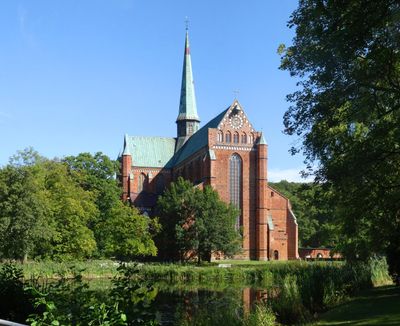
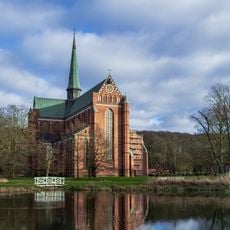
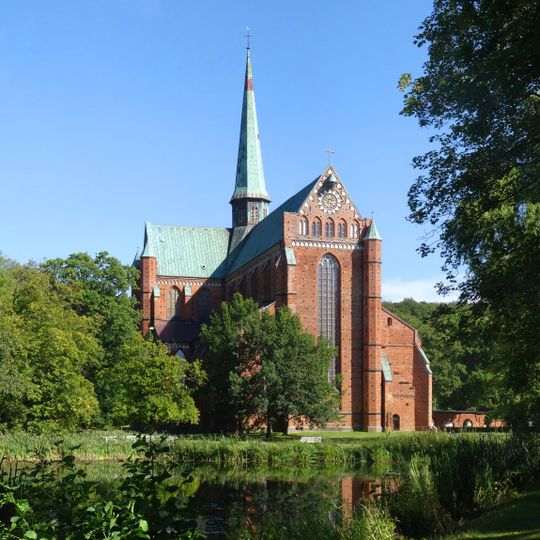
Doberan Abbey is a former Cistercian monastery in Bad Doberan whose church, Doberan Minster, is a Brick Gothic building of red brick with a steep green roof, stepped gables and a slender spire with a green copper top. Its main facade has a circular window above three arched windows, topped by a cross, and a tall pointed-arch window stands on the side. The minster stands beside a body of water among trees.
Doberan was the first monastery in Mecklenburg, founded in 1171 at Althof by Cistercians from Amelungsborn under Prince Pribislaw. In 1179 the community was killed in the unrest after his death; the abbey was refounded at Doberan in 1186. A Romanesque church was consecrated in 1232, and after a fire in 1291 the Gothic minster was built from about 1295 and consecrated in 1368. The abbey was secularised in 1552.
Since the 13th century Doberan was a pilgrimage site because of the "Holy Blood", a host relic kept in the high altar of the Minster. The monastery also held the right, granted in 1218, to settle craftsmen within its precinct.
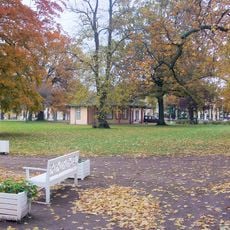
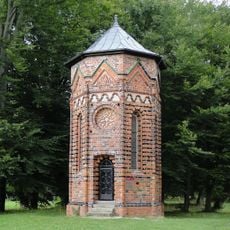
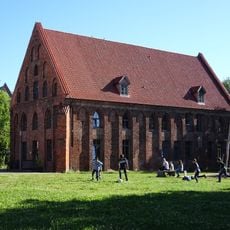
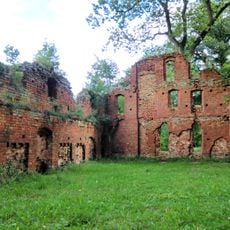
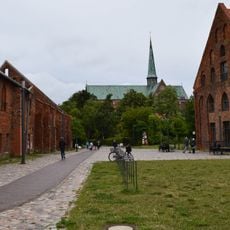
The minster stands beside a pond in Bad Doberan, with the abbey grounds and remaining monastic buildings around it. The church is still in active use, so visits may be interrupted by services. The 1883–1896 Gothic Revival restoration was reversed in the 1960s and 1970s, so the interior seen today reflects the medieval fabric rather than the 19th-century scheme.
The abbey church holds the grave of Margaret Sambiria, queen consort of Denmark, who died in 1282. The medieval church also served as the burial place of the Princes of Mecklenburg, including Magnus II, Duke of Mecklenburg, and Albert of Sweden. The building was used as a storage depot in 1637 during the Thirty Years' War and as an ammunition dump under French occupation between 1806 and 1813.
The community of curious travelers
AroundUs brings together thousands of curated places, local tips, and hidden gems, enriched daily by 93,098 contributors worldwide.