Schloss Heiligenberg, Heritage castle on Heiligenberg mountain in Jugenheim, Germany
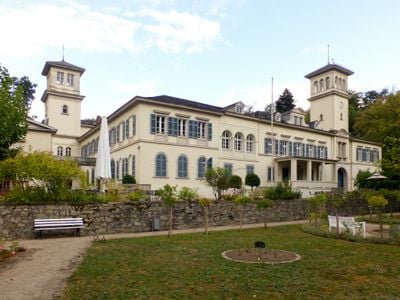
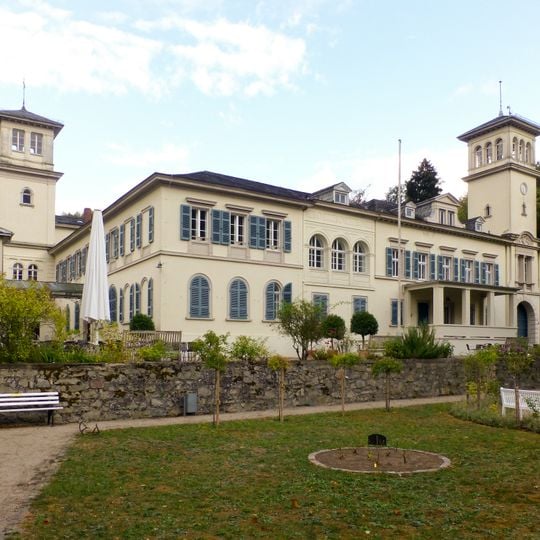
Schloss Heiligenberg is a multi-part castle east of Jugenheim, built from 1813 as an estate and expanded from about 1831 by Georg Moller. Its central block has tall windows with light blue shutters above arched windows; a projecting wing with a small spire stands left, a taller hipped-roof tower right. A stone retaining wall, lawn and white bench sit in front.
August Konrad Hofmann built a farm estate here between 1813 and 1816, possibly with input from architect Georg Moller. In 1827 he sold it to Grand Duchess Wilhelmine, who from about 1831 had Moller enlarge it into a castle. From 1862 her son Prince Alexander of Battenberg and his wife Julia Hauke rebuilt it, and until 1914 it hosted the Russian tsar and other royalty.
The castle's name comes from the Heiligenberg hill, and its Gartensaal and courtyard now host art exhibitions and concerts. Since 2012 a room serves as the civil wedding venue of Seeheim-Jugenheim, and the Juremer Kerb fair has opened here since 2014.
The castle is owned by the state of Hesse and houses a restaurant plus rooms used for seminars and civil wedding ceremonies; the Gartensaal and courtyard host art exhibitions and concerts. The 1995-founded association Kultur im Schloß Heiligenberg runs musical events each year, and since 2014 the Juremer Kerb fair opens here. A Christmas market has been held in the courtyard since 2015.
The castle's Russian imperial link runs through the Battenberg line: Alexander of Hesse and Julia Hauke, Princess of Battenberg, founded the family whose English branch became Mountbatten in 1917. Their daughter Louise, born at Heiligenberg in 1889, became Queen of Sweden in 1950.
The community of curious travelers
AroundUs brings together thousands of curated places, local tips, and hidden gems, enriched daily by 93,093 contributors worldwide.