Burg Tannenberg, Medieval castle ruins in Seeheim-Jugenheim, Germany
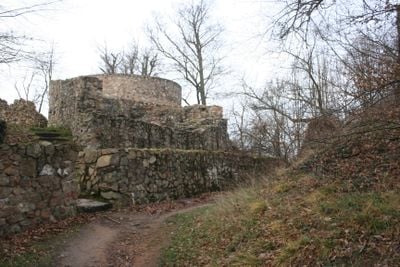
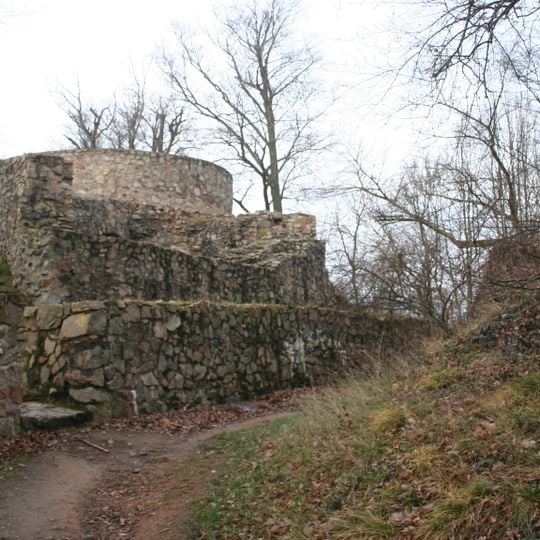
Burg Tannenberg is a ruined hilltop castle on the 339.5-metre Tannenberg above Seeheim. Its irregular stone walls rise in stepped tiers, with a tall curved section, a broad lower wall and a retaining wall in front; moss and white staining mark the stone, and a small circle-with-cross mark is carved on the lower wall. Surviving parts include curtain walls, outer bailey walls, building foundations with cellars, and the base of the cylindrical keep.
Burg Tannenberg was begun around 1210 by Kuno von Münzenberg, whose family took the name von Tannenberg; his son Ulrich I completed it around 1230 to secure the southern Amt Tannenberg and Seeheim. First documented in 1239 as Burg Seeheim, it passed through the Münzenberg inheritance to several co-owners (Ganerben). In 1399 the castle, held by Hartmut the Younger of Cronberg and occupied by 65 men, was besieged by the Rhenish electors and cities; the Frankfurt gun threw basalt balls of 500 to 550 kg, and after about 40 shots breached the walls and a powder explosion wrecked the keep, the garrison surrendered. It was never rebuilt and later served as a quarry.
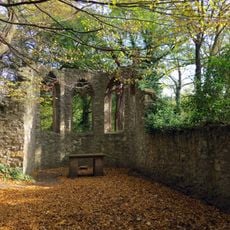
The castle's name comes from the Tannenberg hill, and its 14th-century residents left glazed floor tiles and a type of Gothic stove later named after the site. Excavations in 2002 uncovered the separate chapel of St John the Baptist, about 9 by 5 metres, with its altar base rebuilt in the grass.
The ruin stands on the 339.5-metre Tannenberg above Seeheim, reached on foot through woodland. Since 2015–2017 a metal footbridge and a 21-step stair north of the keep lead to a viewing platform about six metres up, with a round grille at its centre; from there the Rhine plain, Frankfurt to the north and Mannheim to the south are visible. Sturdy shoes are needed on the uneven, leaf-strewn ground.
The 1849 excavations by Hefner and Wolf, among the earliest studies of medieval archaeology, yielded the Tannenberg bronze handgun, one of the oldest known hand-held firearms in the world. It is now kept in the German National Museum in Nuremberg.
The community of curious travelers
AroundUs brings together thousands of curated places, local tips, and hidden gems, enriched daily by 93,700 contributors worldwide.