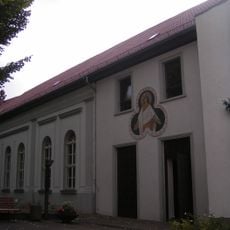
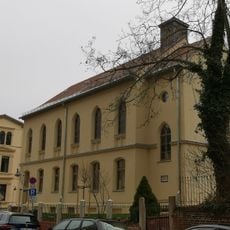
Mauritianum, Natural history museum in Altenburg, Germany
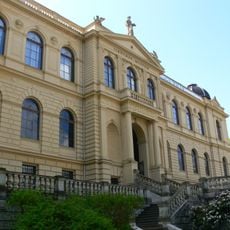
The Mauritianum is a natural history museum in Altenburg, built in 1907/08 to plans by state building director Alfred Wanckel on a plot beside the Schlossgarten given by the ducal family. It holds about 40,000 objects and also houses the meeting rooms of the Naturforschende Gesellschaft des Osterlandes, founded in 1817.
The Naturforschende Gesellschaft des Osterlandes, founded in 1817, kept its natural history collection and library in unsuitable premises for years. On its request, the Saxe-Altenburg Landtag funded a new museum building on land provided by the ducal family at the edge of the Schlossgarten. Built in 1907/08 to plans by state building director Alfred Wanckel, it opened in 1908 and was named after Prince Moritz of Saxe-Altenburg, the society's president who died in 1907 and brother of Duke Ernst I.
The museum is named after Prince Moritz of Saxe-Altenburg, president of the Naturforschende Gesellschaft des Osterlandes, who died in 1907; he was a brother of the reigning Duke Ernst I. The society, founded in 1817, still meets in the building, and the journal "Mauritiana" continues its "Mittheilungen aus dem Osterlande", published since 1837.
The museum stands at the edge of the Schlossgarten, and the building was fully renovated in 2004 and 2005, so the exhibition rooms and the meeting rooms of the Naturforschende Gesellschaft des Osterlandes are housed under one roof. The roughly 40,000 objects are shown in thematic sections, and the ethnological pieces returned from Wittenberg in 2011 form a separate group.
The museum's best-known object is the world's largest known rat king: a mummified cluster of rats whose tails are knotted together. It sits within a collection of roughly 40,000 objects, alongside about 1,500 ethnographic pieces returned in 2011 after decades on loan to the Julius-Riemer-Museum in Wittenberg.
The community of curious travelers
AroundUs brings together thousands of curated places, local tips, and hidden gems, enriched daily by 93,100 contributors worldwide.