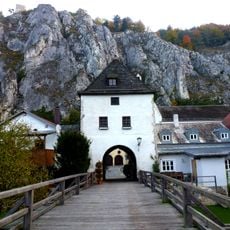
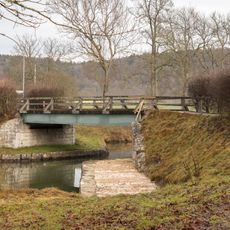
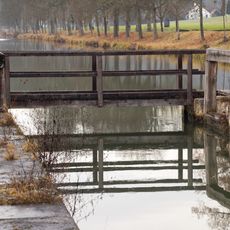
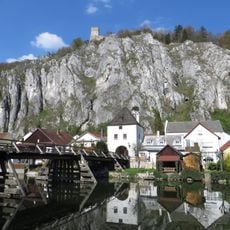
Wooden bridge at Essing, Wooden pedestrian bridge in Essing, Germany
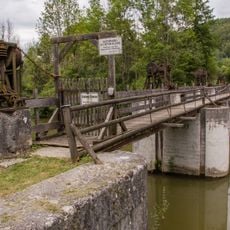
The Holzbrücke bei Essing is a stress-ribbon bridge for pedestrians and cyclists over the Main-Danube Canal and a bypass road. Its nine glued-laminated timber main beams, each 200 m long with a 22 × 65 cm cross-section, hang freely in catenary curves between supports and are spliced on site from 40 m sections. The deck is 3.4 m wide, with a 3.1 m shared foot and cycle path, and the bridge has four spans of 31 + 32 + 74 + 35 m.
The bridge was built from 1978 to 1986 after seven years of planning; its design came from Richard Johann Dietrich, with structural calculations by Heinz Brüninghoff and the Technical University of Munich. At 189.91 m it was Europe's longest wooden bridge until the Drachenschwanz in Ronneburg surpassed it in 2006. Its use of laminated timber as tension bands won the Bavarian engineering timber construction prize in 1988.
The bridge bears the name Tatzelwurm, referencing a dragon-like creature from local folklore. This name choice reflects how the curved structure winds through the landscape like the legendary animal it references.
The bridge carries pedestrians and cyclists over the Main-Danube Canal and a bypass road; vehicles may use it if needed. Its deck is 3.1 m wide within a 3.4 m overall width. The structure clears the canal's highest navigable water level by 7.0 m at mid-channel.
The bridge's nine main beams are 200 metres long with a cross-section of 22 by 65 centimetres, yet they hang freely between supports and carry loads mainly in tension. Delivered in 40-metre sections and glued on site by finger jointing, they let the structure bear 500 kilograms per square metre. The two columns take only about 10% of the forces.
The community of curious travelers
AroundUs brings together thousands of curated places, local tips, and hidden gems, enriched daily by 93,878 contributors worldwide.