Blühendes Barock, Baroque gardens in Ludwigsburg, Germany
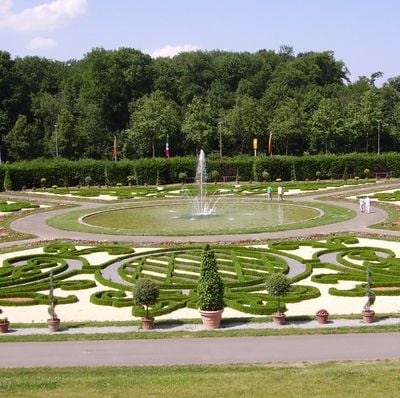
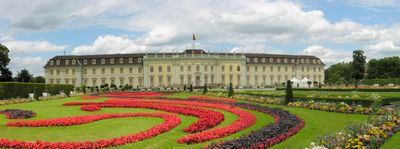
Blühendes Barock is the name of the 30-hectare gardens surrounding Ludwigsburg Residential Palace on three sides. The south side forms the main entrance, where a broad approach path is interrupted by a round lake, flanked by gardens in the French baroque style. The north garden holds terraces and a baroque broderie around a basin with a central fountain, and the east garden is laid out in the English style in two parts.
Gardens were laid out north and south of Ludwigsburg Palace from 1704 under Duke Eberhard Ludwig, then enlarged and redesigned under Duke Carl Eugen. The east garden followed from 1797 under Duke Friedrich II, and in 1828 King Wilhelm I opened the grounds to the public and put them to agricultural use. For the 250th anniversary of palace and town in 1954, Albert Schöchle recreated the gardens from 1953, partly historically, partly freely after the Baroque; the opening as Blühendes Barock took place on 23 April 1954.
The Märchengarten opened in 1959 on Albert Schöchle's initiative, after he saw the Dutch fairy-tale forest at Efteling. More than 40 scenes are shown; the first nine, among them Hansel and Gretel and Cinderella, survive almost unchanged. At the upper entrance a stone dragon calls "Bitte Papier" and thanks anyone who feeds it a scrap of paper.
The park is open to visitors from March through November and offers pathways suited to different walking levels. Families can explore at their own pace, and there are seating areas throughout where you can rest.
The stone dragon at the upper entrance to the Märchengarten calls out "Bitte Papier"; drop a scrap of paper into its throat and it answers "Danke!". The grotto nearby is the largest surviving ice cellar of a south German palace, its vault about 9.5 m high and 4.2 m wide, its shaft covered by a thatched hut.
The community of curious travelers
AroundUs brings together thousands of curated places, local tips, and hidden gems, enriched daily by 93,005 contributors worldwide.