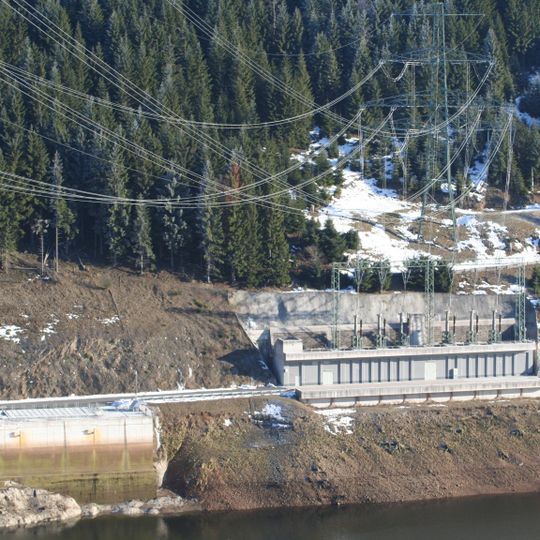
Goldisthal Pumped Storage Station, Pumped-storage power station in Thuringian Mountains, Germany
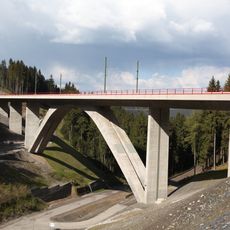
Goldisthal Pumped Storage Station is a hydroelectric facility in the Thuringian Mountains that moves water between two reservoirs to generate power. The upper reservoir holds 12 million cubic meters of water while the lower one stores roughly 19 million cubic meters, with both connected through underground tunnels.
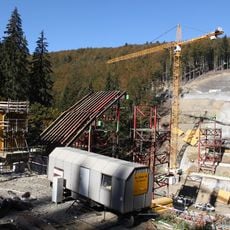
The project emerged after three decades of planning, with construction beginning in 1997 and initial operation in 2003. Full capacity was reached a year later, marking a major milestone in Germany's hydroelectric storage capabilities.
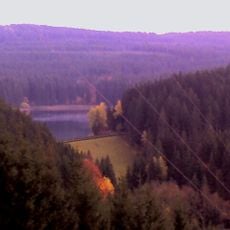
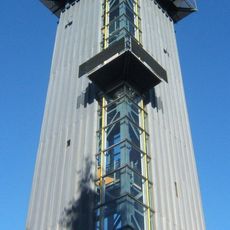
The name Goldisthal comes from the village on the Schwarza, and the plant's two artificial lakes have become an excursion destination for people interested in energy. A visitor centre at the power station and viewing platforms are open to visitors, and 6,000 to 7,000 people a year have been guided through the underground caverns. Swimming and boating on either lake are banned because the water levels shift by several metres and strong currents and whirlpools form.
Guided tours of the underground machine cavern, 137 m long and 49 m high, must be booked in writing well in advance because demand is high; 6,000 to 7,000 people a year are taken through. The visitor information centre and viewing platforms are the other access points. Swimming, boating and any water sports on the upper and lower reservoirs are prohibited, as water levels shift by several metres and strong currents and whirlpools form.
Two of the four generator units use variable-speed technology, an innovation deployed for the first time in a major European hydroelectric project. This technical feature allows the facility to respond more efficiently to fluctuating power demand.
The community of curious travelers
AroundUs brings together thousands of curated places, local tips, and hidden gems, enriched daily by 94,162 contributors worldwide.