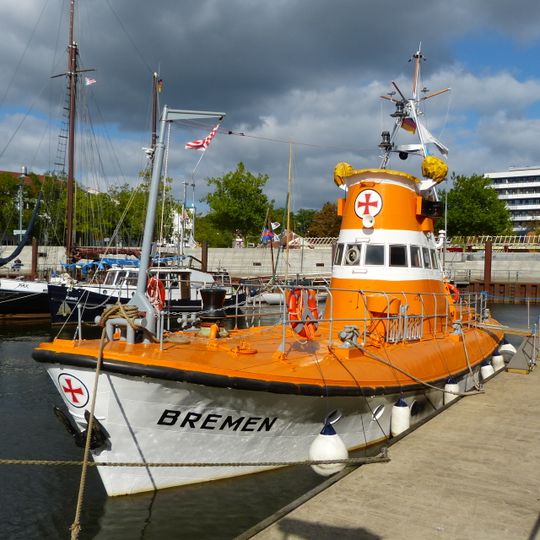
Bremen, Sea rescue cruiser in Vegesack, Germany
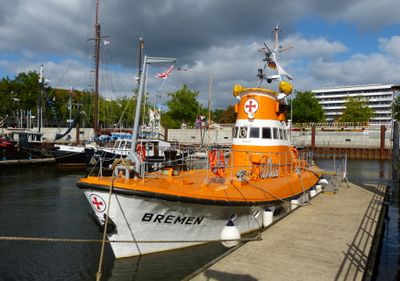
The Bremen is a preserved steel sea rescue cruiser, built in 1931 by the Lürssen shipyard in Bremen-Vegesack as the double-screw motor lifeboat Konsul Kleyenstüber. Rebuilt from 1951, it gained a rear well with a hydraulically closed stern gate for a 5.08-metre daughter boat, a rounded light-metal whaleback deck and a closed turret, making it the DGzRS's first self-righting lifeboat.
Built in 1931 at the Lürssen shipyard in Bremen-Vegesack as yard no. 12290, the boat entered DGzRS service as Konsul Kleyenstüber (KRD 424). It was stationed at Pillau from 1931 to 1940, on Borkum from 1940 to 1944, and on Amrum from 1946 to 1949, when it was decommissioned. Renamed Bremen, it was rebuilt from 1951 into the first experimental sea rescue cruiser, testing the daughter-boat system.
The ship's name changed with its role: built in 1931 as Konsul Kleyenstüber, it took the name of the Hanseatic city Bremen in 1944 as the third DGzRS boat of that name. Its experimental daughter-boat system, tested from 1953, became the model for all later German sea rescue cruisers.
The Bremen is a preserved museum ship, no longer on active rescue duty, so there is no emergency readiness to observe. Visitors encounter the steel hull lengthened by 130 cm during the 1951 rebuild, the hydraulically closed stern hatch and the watertight compartments of the double hull. Look for the rear cradle that held the 5.08 m daughter boat.
The Bremen was the DGzRS's first self-righting rescue boat: after capsizing, its closed aluminium tower and rounded whaleback deck let it roll back upright on its own. The same design, with the stern cradle for the daughter boat, became the pattern for all later German sea rescue cruisers.
The community of curious travelers
AroundUs brings together thousands of curated places, local tips, and hidden gems, enriched daily by 92,885 contributors worldwide.