Bonhoeffer-Haus, Literary museum and memorial house in Charlottenburg, Germany.
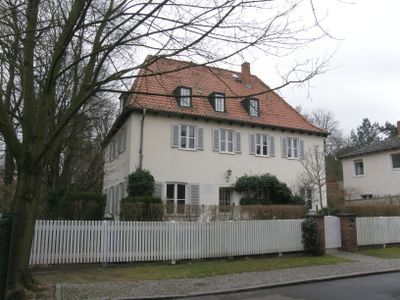
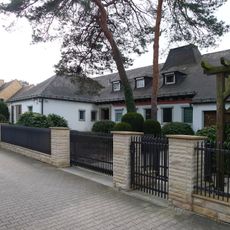
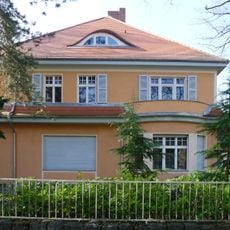
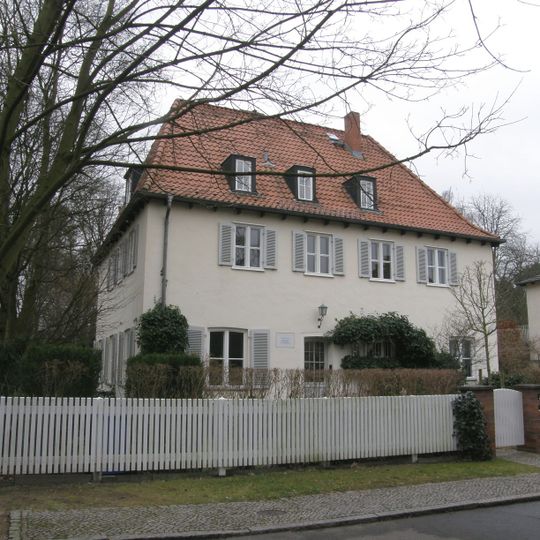
The Bonhoeffer-Haus at Marienburger Allee 43 in Berlin-Charlottenburg is a two-storey house with a high hipped roof, designed by Jörg Schleicher. Its garden facade is strictly symmetrical, while the street front is asymmetrical with offset axes. The windows are four-pane casement windows with folding shutters. Inside, a central hall leads to the former living rooms; upstairs, Dietrich Bonhoeffer's study has been restored to its original state.
The house at Marienburger Allee 43 was designed by architect Jörg Schleicher as a retirement home for Karl Bonhoeffer and his wife Paula von Hase, and the family moved in in 1935. In Dietrich Bonhoeffer's attic study he wrote parts of 'Ethik' and 'Nach zehn Jahren', and the house hosted conspiratorial meetings of the resistance. On 5 April 1943 the Gestapo arrested Dietrich Bonhoeffer here. In 1951 the Evangelical Church acquired the house; after use as a student centre and self-administered dormitory, it was converted from 1984 to 1987 and opened as a memorial and meeting place on 1 June 1987.
The house commemorates Dietrich Bonhoeffer, a theologian whose thinking is visible through preserved books and handwritten notes throughout the rooms. The spaces show how religious conviction and political resistance were intertwined in this household.
A visit works best with advance notice, especially if joining a guided tour. The house sits in a quiet residential area that is walkable, with other museums nearby.
On the upper floor, Bonhoeffer's study remains unchanged with desk and bookshelves arranged as he used them daily. This makes the room an intimate window into his daily life and intellectual work.
The community of curious travelers
AroundUs brings together thousands of curated places, local tips, and hidden gems, enriched daily by 92,866 contributors worldwide.