Frauenalb Monastery, Monastic ruins in Marxzell, Germany.
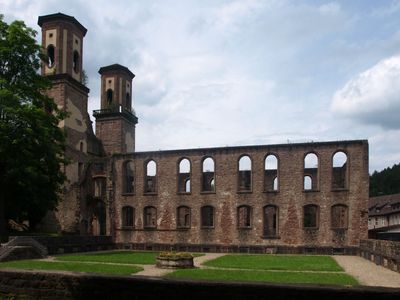
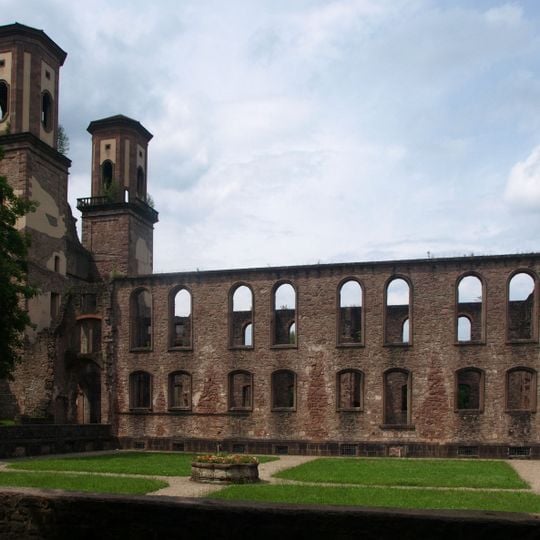
Frauenalb Monastery is a weathered ruin of reddish-brown stone and brick in the upper Alb valley. Two square towers with arched windows and small balconies stand at one end; a long two-storey wall beside them is pierced by two rows of tall, narrow, round-headed openings, eight above and eight smaller rectangular ones below. A low curved stone basin lies in the grass in front.
Eberhard III of Eberstein and his mother Uta founded the convent shortly before 1185; a fire in 1508 destroyed the abbey and convent buildings, leaving only the church rebuilt in 1404–1406 and the infirmary. Margrave Ernest Frederick dissolved the house in 1598, and after secularisation in 1803 factories moved in. Four fires between 1835 and 1853 left the complex as burnt-out ruins.
The monastery reveals how religious communities lived and worshipped during medieval times. The place was a center for educated women from noble families, who spent their days here with prayer, crafts, and learning.
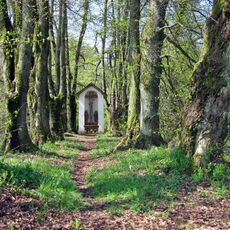
The ruin stands in the upper Alb valley on the Klosterpfad between Frauenalb and Bad Herrenalb, where old signs mark the historic Baden-Württemberg border, today the line between the Karlsruhe and Calw districts. A hand-cranked "Zollhäusle" there tells the border's story. The site is reached on foot; the masonry is weathered and the ground uneven.
Near the ruin, on the Klosterpfad toward Bad Herrenalb, old signs mark the historic border between Baden and Württemberg, today the line between the Karlsruhe and Calw districts. A small "Zollhäusle" there tells the border's story when you turn a hand crank.
The community of curious travelers
AroundUs brings together thousands of curated places, local tips, and hidden gems, enriched daily by 93,660 contributors worldwide.