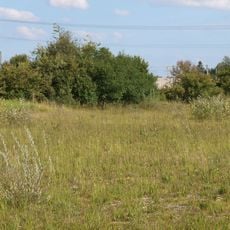
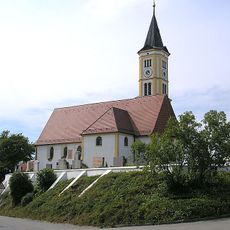
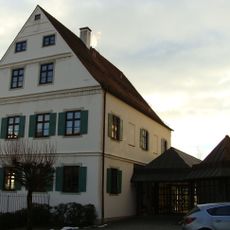
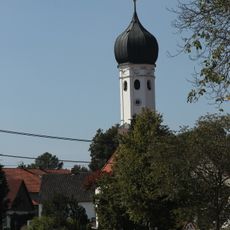
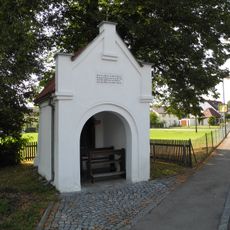
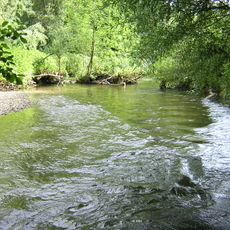
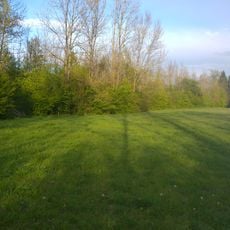
Burgstall Kissing, Medieval castle ruins in Kissing, Germany
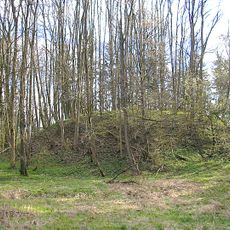
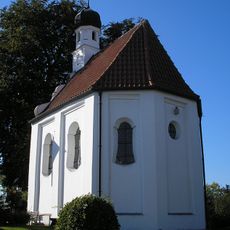
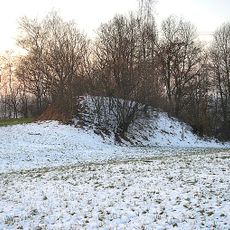
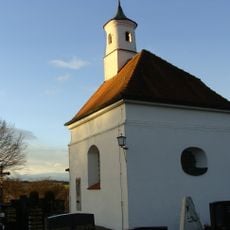
Burgstall Kissing is a high medieval motte-and-bailey castle on the Lechleite southeast of Altkissing. Its main mound, about eight metres high with a plateau of roughly 12 by 18 metres, was encircled by a wall with four bastions in the high Middle Ages. The northern bailey is separated by a ditch 1.5 to 3 metres deep, and the plateau is now occupied by a cross-shaped Baroque chapel.
Built around 1000 as a small motte, the castle was the seat of the lords of Kissing, first documented in 1085 with Adalbero de Chissingin. It lay within Welf territory facing Augsburg and was abandoned in the High Middle Ages; finds point to a stone phase around 1200. By 1498 sources call it the "Burgkstal", with the outer bailey used as farmland.
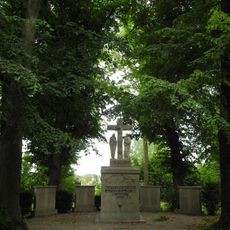
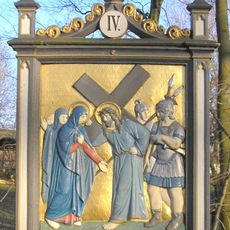
The name Burgstall refers to the abandoned castle site, documented as "Burgkstal" in 1498, when the inner bailey was used as a field. Since 1907 the northern bailey has served as a Stations of the Cross path with cast-iron stations, and since 1922 a war memorial has stood in its centre, commemorating the dead of both world wars since 1956.
The site is reachable via Hörmannsberger Straße on a hillside with free access for visitors. Walking paths connect the ruins to the nearby chapel, making it easy to explore both locations during a visit.
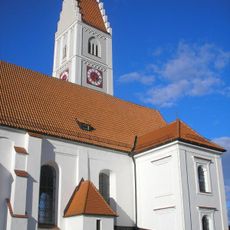
The chapel on the main plateau is not a separate building called Kapelle Burgstallberg: it is the Burgstallkapelle, built from 1681 for the Jesuits and consecrated in 1685, one of the region's first Baroque buildings. Its cross-shaped dome structure replaced a Martersäule mentioned in 1641, part of whose masonry image column was set into the altar mensa.
The community of curious travelers
AroundUs brings together thousands of curated places, local tips, and hidden gems, enriched daily by 94,076 contributors worldwide.