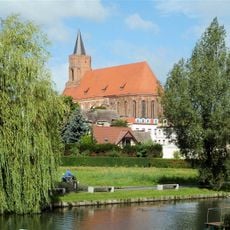
Burg Beeskow, Medieval castle in Beeskow, Germany.
Burg Beeskow is a moated castle in Beeskow, Brandenburg, first mentioned in 1272 and held by the lords of Strele. Its grounds combine a palas and a bergfried, and the east wing burned out in 1945. Since 1991 it has housed a regional museum, a medieval torture chamber exhibit, the Beeskow Art Archive with some 23,000 objects, and a music museum opened in 2018.
Burg Beeskow was first mentioned in a document in 1316 and, like Storkow Castle, belonged to the lords of Strehle, forming a defensive line of water castles in the Mittelmark. In 1518 Ulrich von Bieberstein mortgaged it to Dietrich von Bülow, Bishop of Lebus, who rebuilt it as his episcopal residence for 4,834 guilders. After 1556 it passed to Margrave Johann I of Brandenburg-Küstrin and in 1575 to the Brandenburg electors; from 1625 to 1627 Gebhard XXIII von Alvensleben held it in pledge, and until 1915 it served the Hohenzollerns as an administrative building.
The castle serves as a cultural center displaying rotating exhibitions of paintings, sculptures, and graphic works within its rooms. Visitors encounter contemporary and historical art throughout the castle spaces.
Burg Beeskow stands on an island-like site in the town of Beeskow, in the Oder-Spree district of Brandenburg. The castle courtyard and the ramparts behind the castle were fully renovated in 2022, so the outdoor areas are in good condition. The regional museum, the medieval magazine with its torture cellar, the music museum and the Kunstarchiv are all housed inside the complex.
The Music Museum houses hundreds of instruments from the 1800s, including orchestrions and automatic pianos. These rare mechanical music devices show a forgotten technology from before electronic equipment existed.
The community of curious travelers
AroundUs brings together thousands of curated places, local tips, and hidden gems, enriched daily by 93,100 contributors worldwide.