Uni-Center, Residential high-rise building in Sülz, Germany
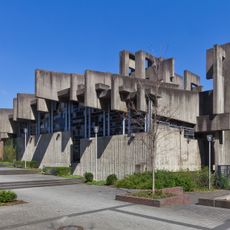
Uni-Center is a large residential building with a Y-shaped form rising 134 meters high, its three wings painted in orange, green, and yellow. The lower floors house shops, restaurants, and a parking garage, while nine elevators serve around 1,200 residents across 45 floors and 968 apartments.
Werner Ingendaay designed the Uni-Center for the developer Deba Wohnbau CCAA GmbH; work began in January 1971, and federal transport minister Lauritz Lauritzen laid the foundation stone that February, calling the project a "bold experiment". The topping-out ceremony for the Y-shaped tower followed in October 1972, and the building was ready for occupancy on 1 August 1973.
The three wings are colour-coded for orientation: U in orange, N in green, I in yellow. The I block belongs to the Cologne student services organisation, which runs 378 rooms of 14 to 24 square metres; the remaining units were sold as owner-occupied flats. The building appears in the 1975 film adaptation of Heinrich Böll's Die verlorene Ehre der Katharina Blum.
The three wings are colour-coded for orientation: U in orange, N in green, I in yellow, and the colour scheme continues inside each wing. Nine lifts serve the building. The lower floors hold shops, restaurants and a multi-storey car park, while flats begin on the 5th floor.
During the German Autumn, RAF members rented a flat in the Uni-Center under a false name to prepare the kidnapping of Hanns Martin Schleyer. In October 1977 GSG 9 searched several flats and established that Adelheid Schulz had rented one as "Markward" until the end of September 1977; the Landshut hijacking happened during the search.
The community of curious travelers
AroundUs brings together thousands of curated places, local tips, and hidden gems, enriched daily by 94,049 contributors worldwide.