GeoMuseum der Universität, Natural history museum in Cologne, Germany
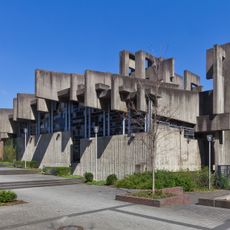
The GeoMuseum is the natural science museum of the University of Cologne's Faculty of Mathematics and Natural Sciences, housed in the lecture building of the geoscience institutes at Zülpicher Straße 49b. Its roughly 50,000 specimens fill a single hall, covering meteorites and tektites, minerals of Siegerland mining, Russian minerals, quartz varieties, calcite forms, zeolites, gemstones and synthetic crystals. Along the left wall, cases trace Earth's history from the solar system's formation to the present, with fossils included.
The museum descends from two separate collections. The Museum für Naturkunde, founded in 1881, was housed in the Severinstorburg until 1902 and then in the Stapelhaus until 1945. The Mineralogisch-Geologische Sammlung was created in 1920 and from 1938 occupied the Rundbau, a fortress building near the Südbahnhof. Both were largely destroyed in the Second World War and rebuilt by Georg Kalb and Karl Jasmund for mineralogy and Martin Schwarzbach for geology. In 1962 the minerals and rocks rescued from the destroyed Stapelhaus came to Cologne as a loan from the city, and in 2000 the main geological exhibits were merged with the minerals as the GeoMuseum.
The museum's name and setting tie it to the University of Cologne's Faculty of Mathematics and Natural Sciences, and it is the city's only natural history museum. Its single hall groups meteorites and tektites, minerals from Siegerland mining, Russian minerals, quartz varieties, calcite forms, zeolites, gemstones and synthetic crystals. A display case in the foyer with corals and reef-building organisms can be seen even outside opening hours.
The GeoMuseum occupies a single hall in the lecture-building complex of the geoscience institutes at Zülpicher Straße 49b. It opens Wednesdays from 14:00 to 19:00 and on the last Sunday of each month from 14:00 to 17:00. A large coral display case in the foyer can be seen even outside opening hours.
The museum is a registered repository for type material of the minerals brownmillerite, jasmundite and mayenite in the German type mineral catalogue, and for chlormayenite in the IMA catalogue under the code MMUKö-Köln. In the foyer, outside opening hours, stand a 1,400-year-old mammoth tree disc from the USA and the stump of a fossil Miocene mammoth tree from the Berrenrath West lignite mine near Frechen.
The community of curious travelers
AroundUs brings together thousands of curated places, local tips, and hidden gems, enriched daily by 94,032 contributors worldwide.