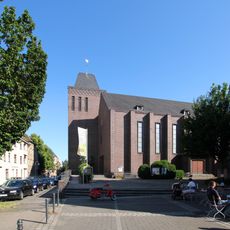
Geusenfriedhof, Protestant cemetery in Lindenthal, Germany.
Geusenfriedhof is the oldest Protestant cemetery in the Rhineland, laid out in Lindenthal outside the former Weyertor gate. The grounds hold 144 flat grave slabs, about 50 low stelae and around 30 Classical-era monuments, with ivy covering the ground between the graves. A round path and two cross paths make the site walkable; a cast-concrete altar from 1964, moved here from the Jeremiah house in 2006, stands at its centre.
The cemetery was founded in 1584 and became the first Protestant burial ground in Cologne at a time when Protestants faced persecution and restrictions. Its creation marked a turning point in the city's religious history by finally offering Protestants their own place for the dead.
The gravestones show Protestant design principles with simple forms that deliberately contrast with the elaborate monuments of Catholic cemeteries from that era. This plainness reflects religious beliefs and shapes how the cemetery looks today.
The grounds are walkable via one circular path and two cross paths; individual graves are no longer linked by paths and the ground between them is densely covered with ivy. Some old flat slabs are conserved on new bases, others are overgrown and weathered. The site has been under monument protection since 1981 and is tended partly by volunteers.
The name derives from "Geusen", the Dutch rebels of the Eighty Years' War (1568–1648), whose French nickname "gueux" meant beggars. The cemetery opened on 24 June 1576 on a 2,700 m² plot that Ursula von Gohr zu Kaldenbroek, daughter of imperial chamberlain Ailf von Wyenhorst, had given the city; the first burial followed in 1582.
The community of curious travelers
AroundUs brings together thousands of curated places, local tips, and hidden gems, enriched daily by 94,158 contributors worldwide.