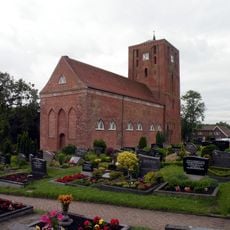
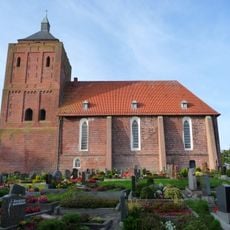
Orgel der Marienkirche, Pipe organ in Marienhafe, Germany
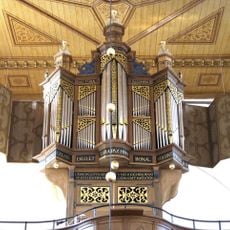
The organ of the Marienkirche in Marienhafe is a Baroque instrument with 20 registers on two manuals and an attached pedal, built by Gerhard von Holy between 1710 and 1713. Its north German Baroque case has a polygonal, richly carved front with a central tower and two side sections, and the Rückpositiv is nearly identical in structure. The principals in the prospect and all aliquot and mixture stops survive in original form.
Gerhard von Holy built the organ between 1710 and 1713 after the parish contracted him for over 550 gulden; delays and a lawsuit over payment pushed completion to 11 October 1713. In 1828 Johann Gottfried Rohlfs dismantled it as the east apse was crumbling, and in 1831 he rebuilt it on the west gallery without altering the historic substance. Long thought to be by Arp Schnitger, it was placed under monument protection only in 1952.
The organ was designed to accompany congregational singing, which explains the many registration options for the plenum and the flexible wind supply, still original. Its colourful flute stops already point to 18th-century sound ideals rather than to Arp Schnitger, to whom the instrument was long attributed.
The church opens to visitors who want to examine the organ's preserved components, including the case, bellows, and wind chests. It is best to visit when organ concerts or services take place to hear the instrument being played.
The organ was long attributed to Arp Schnitger because its construction and sound follow the Schnitger school; only later research identified Gerhard von Holy as the builder. Even the front pipes, all aliquot stops and the mixtures survive in their original state, as does the original wind system.
The community of curious travelers
AroundUs brings together thousands of curated places, local tips, and hidden gems, enriched daily by 93,002 contributors worldwide.