Burgruine Flossenbürg, Medieval rock castle in Flossenbürg, Germany
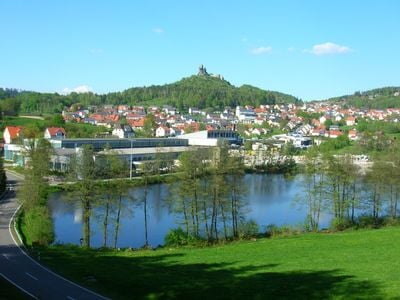
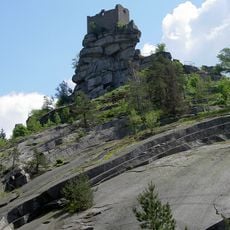
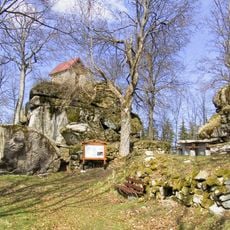
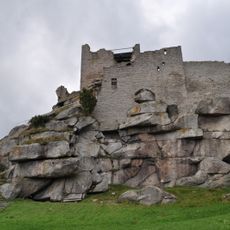
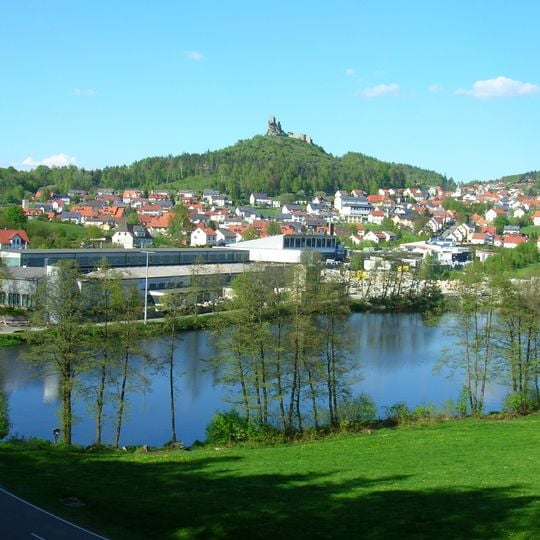
Burgruine Flossenbürg is a medieval rock castle ruin set on a granite outcrop in the Upper Palatinate region of Bavaria, Germany. The complex includes a residential tower, two inner courtyards, and fortified walls that are built directly into the natural rock face.
Count Berengar of Sulzbach founded the castle around 1100; it is first documented in 1125. In 1188 it passed to Emperor Frederick Barbarossa, and in 1212 it fell hereditarily to King Ottokar I of Bohemia. Charles IV bought it in 1353 and installed an office with eight castle men in 1366. In 1634 troops of Bernhard of Saxe-Weimar burned it during their retreat, after which it served the area as a quarry.
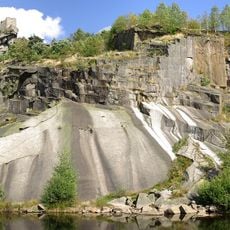
The castle gave its name to the village below and to the granite quarried beneath it until the 1960s. Since 1992 the beech woods on the slopes have been protected as the Schlosshang forest reserve, and the ruin stands within the Schlossberg nature reserve, whose onion-skin granite bedding is exposed on the summit and west side.
The site is open year-round at no charge and the restored tower can be climbed for a view over the surrounding area. Sturdy footwear is a good idea since parts of the path cross uneven granite rock.
The granite summit shows onion-skin exfoliation, a rare weathering pattern exposed by earlier quarrying. The Bavarian Environment Agency lists the Schlossberg as geotope 374A009, awarded the seal "Bavaria's most beautiful geotopes". The rock and ruin form a landmark visible from afar in the Upper Palatinate Forest.
The community of curious travelers
AroundUs brings together thousands of curated places, local tips, and hidden gems, enriched daily by 94,512 contributors worldwide.