Burg Friedestrom, Medieval castle in Dormagen, Germany
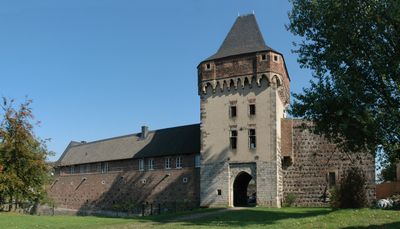
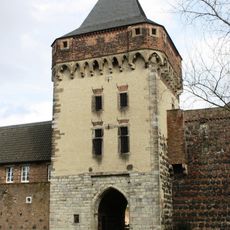
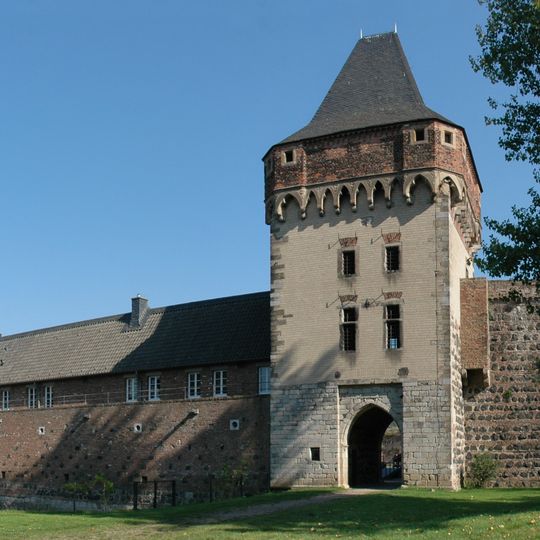
Burg Friedestrom is a former electoral Cologne water castle in Zons, now part of Dormagen. Its surviving square stone tower has a steep slate roof, a band of red brick with arched corbels, and a pointed archway at its base. A long red brick wing with rows of small windows extends to the left.
Archbishop Friedrich III von Saarwerden began building the castle in 1373 on the site of an earlier Zons stronghold that Cologne citizens had razed after the 1288 Battle of Worringen. It secured the Rhine toll moved from Neuss to Zons a year earlier and guarded Cologne's territory against the counts of Berg. The complex was finished in 1377 and integrated into Zons' town walls by 1388.
The name Friedestrom refers to the former Rhine toll that the castle was built to secure after it moved from Neuss to Zons in 1372. Since 1972 the former electoral Cologne castle has housed a cultural centre run by the district, and the site is protected both as an architectural monument and as an archaeological monument.
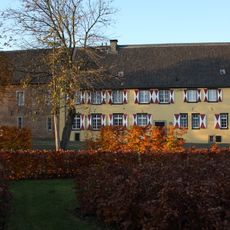
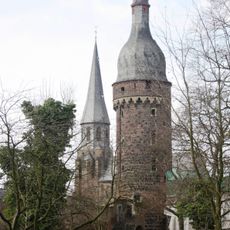
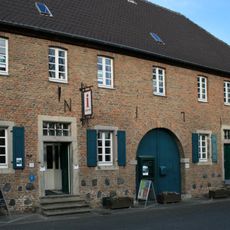
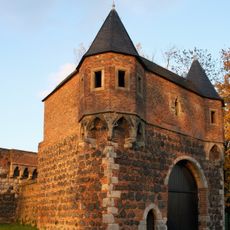
The complex lies on the left bank of the Rhine in Dormagen-Zons and is integrated into the town's medieval fortifications, so it can be reached on foot from the old town. The grounds are protected as both an architectural and an archaeological monument. The surviving buildings are the gate tower, the north wing and the outer bailey with the 17th-century Herrenhaus and Marstall.
The castle's name refers to the Rhine toll: Friedestrom was a Zollburg built from 1373 to protect the customs post moved from Neuss to Zons a year earlier, and it brought in about 5,000 guilders a year. The square stone tower with its brick band and pointed archway is the surviving medieval element a visitor should look for.
The community of curious travelers
AroundUs brings together thousands of curated places, local tips, and hidden gems, enriched daily by 92,798 contributors worldwide.