Burg Adelebsen, Medieval castle in Adelebsen, Germany
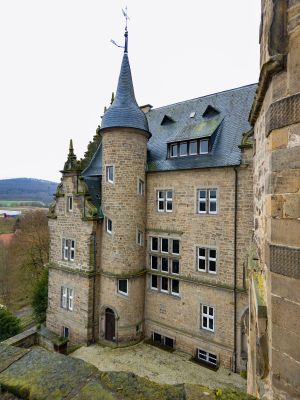
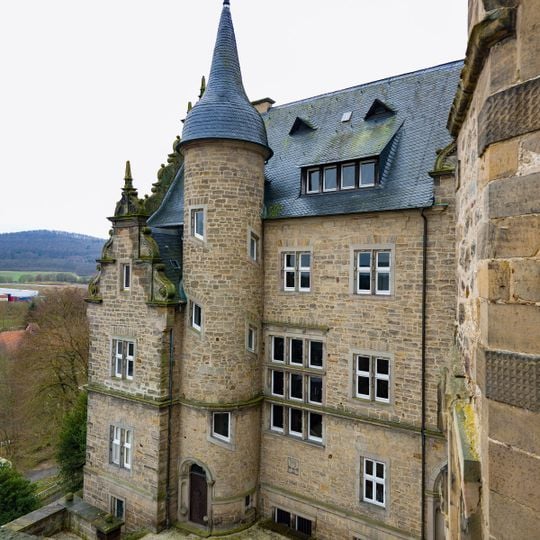
Burg Adelebsen is a castle built on a sandstone cliff at the southern edge of Adelebsen, dominated by a nine-story sandstone tower that serves as both residence and defensive structure. Around this central tower, additional buildings and courtyards complete the fortress complex.
The Lords of Wibbecke moved from their nearby seat to the sandstone rock above Adelebsen in the early 13th century and built the castle over the following years; the family was first recorded as de Adelevessen in 1234, a fixed house was mentioned in 1253 and the castle in 1295. In 1466 the Bishop of Hildesheim set it on fire, and the Thirty Years' War caused heavy damage. Rebuilding began around 1650, and around 1740 the castle was converted into a palace. The male line died out in 1957 with Georg Freiherr von Adelebsen, who had founded the Stiftung Burg Adelebsen in 1947.
The castle displays architectural layers from medieval times through the modern era, reflecting how the place evolved across centuries of occupation. Visitors can see these different periods mixed together as they walk through the rooms and explore the structure.
The castle stands on a sandstone spur southeast of Adelebsen, above the Schwülme valley and the L554. The site is reached on foot; the rock drops 30 m to the valley on the south side. The complex includes the outer bailey with the only surviving castle gate, the main castle, a terraced hill garden and the farmyard in the valley.
The residential tower stands empty today and houses the largest colony of building-nesting jackdaws in southern Lower Saxony. Its lower three storeys were built around 1370 to 1380, the seven above them around 1420 to 1440, of which six survive. The walls are 4.30 m thick at the base and thin to 1.70 m higher up.
The community of curious travelers
AroundUs brings together thousands of curated places, local tips, and hidden gems, enriched daily by 94,439 contributors worldwide.