Burg Hauneck, Medieval castle ruins in Haunetal, Germany.
Burg Hauneck is a castle ruin perched at about 524 meters (1,720 feet) on Stoppelsberg mountain, built from locally quarried basalt stone with sandstone accents. The remains reveal walls, residential spaces, and service areas that reveal how the fortress was laid out and used over time.
The castle was probably built in the 14th century by the knights of Haune to guard their valley castle at Burghaun and to control the Antsanvia road. First mentioned in 1397, it was taken and partly destroyed by Landgrave Hermann II of Hesse after a raid into Lower Hesse. In 1409 Heinrich von Haune was forced to sell it to the landgrave, and Hauneck became a Hessian court and administrative seat. Simon von Buchenau destroyed it in 1469; Wilhelm III had it rebuilt between 1482 and 1490 by Hans Jakob von Ettlingen, and the seat moved to Holzheim in 1560.
The castle's name derives from the Haune river and the knights von Haune, whose seat lay about 3 km away in Burghaun. From 1409 Hauneck served as a Hessian court and administrative seat, with an Amtmann appointed by the landgraves; the first was fortress architect Hans Jakob von Ettlingen, and in 1499 Engelhard von Buchenau styled himself "Amtmann zu Hauneck". The office moved to Holzheim in 1560.
The ruins can be reached by several hiking trails through the surrounding hills, with options for shorter or longer walks depending on your pace. The terrain is uneven with old stones and slopes, so wear sturdy shoes and watch your footing carefully.
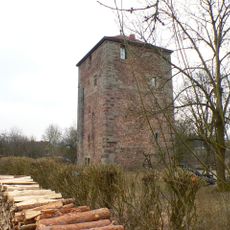
The castle keep stands directly on hexagonal basalt columns formed as lava cooled; these columns are visible at its base. The gate and window lintels, corner stones and bossed ashlars are made of white sandstone from the Lange Steine natural monument.
The community of curious travelers
AroundUs brings together thousands of curated places, local tips, and hidden gems, enriched daily by 92,894 contributors worldwide.