Burg Löwenstein, Medieval castle ruin in Bad Zwesten, Germany.
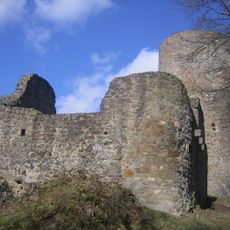
Burg Löwenstein is a ruined hilltop castle on the Ortberg at 341.2 m above sea level near Oberurff-Schiffelborn in Bad Zwesten. Its 26-metre keep, with a high entrance at 7 m reached by a drawbridge, survives; the main castle had five manor houses and a chapel first mentioned around 1300, while the outer bailey held workshops, a bakehouse, a brewhouse and stables within a 450-metre ring wall.
Werner II von Bischoffshausen completed the castle in 1236 as a fief of the Thuringian landgraves; it was first documented in 1253. He named it Löwenstein after the lion in the coat of arms of his wife Gertrud von Itter. In 1247 he backed Duchess Sophie of Brabant in the Thuringian-Hessian succession war, and the castle later passed to three family lines who held it jointly.
The name Löwenstein comes from Gertrud von Itter, whose family coat of arms bore a lion; her husband Werner II von Bischoffshausen named the castle after her. The castle was a Ganerbenburg, held jointly by three family lines—Löwenstein-Schweinsberg, Löwenstein-Westerburg and Löwenstein-Romrod—who lived there together into the 14th century. The chapel, first mentioned around 1300, held its last service in 1710.
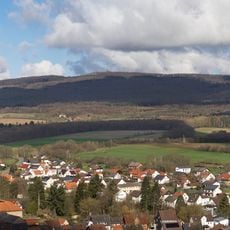
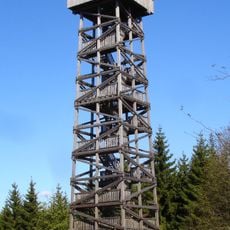
You can climb about 80 steps to reach a viewing platform roughly 26 meters high inside the keep. From the top, you see across Bad Zwesten and the valley toward Schwalmpforte.
The keep's high entrance lay 7 metres up, reached by a drawbridge from a neighbouring residential building that no longer exists; a guard room stood in the entrance area, with a windowless dungeon below it.
The community of curious travelers
AroundUs brings together thousands of curated places, local tips, and hidden gems, enriched daily by 92,642 contributors worldwide.