Burgruine Osternohe, Medieval castle ruin in Schnaittach, Germany.
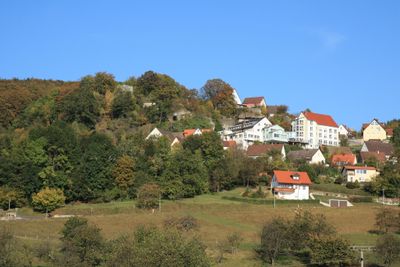
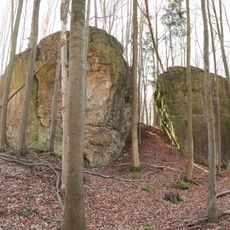
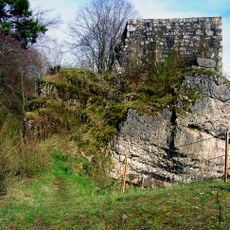
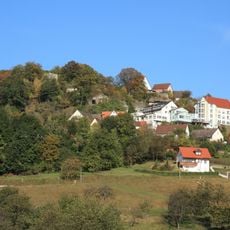
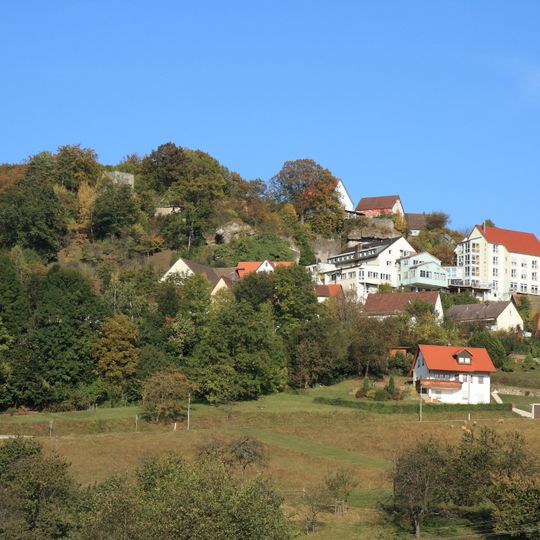
Burgruine Osternohe is a ruined hilltop castle on a rocky spur of the Schlossberg at about 515 metres, above the village of Schloßberg near Schnaittach in Middle Franconia. Only fragments of grey masonry survive, including a straight wall segment and a rough opening in the rock; the upper castle is freely accessible as a viewpoint, while the lower castle is largely private.
Osternohe first appears in 1169 with the noble Poppo de Osternahe, and the hill castle was documented as "castrum Osternach" in 1228. Nuremberg troops burned the lower bailey on 9 March 1450 during the First Margrave War; it was rebuilt after 1457. Nuremberg mercenaries plundered and fired the castle on 23 May 1553 in the Second Margrave War, and it served as a margravial administrative seat until 1722. After 1766 a lightning strike damaged the keep and the remaining buildings were quarried for stone.
The name Osternohe first appears in 1169 with the nobleman Poppo de Osternahe. The most prominent member of the family, Poppo IV, took part in Emperor Frederick II's crusade to Jerusalem in 1229, fought at the Battle of Liegnitz in 1241 and served as Grand Master of the Teutonic Order from 1253 to 1257. He is buried in Mallersdorf Abbey.
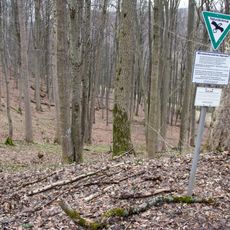
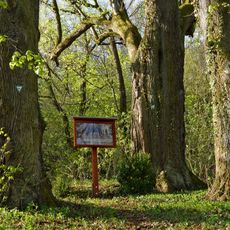
The ruin is accessible via several hiking trails with an informational sign board explaining its history. Wear sturdy shoes since the terrain is uneven and some paths are steep.
The keep visible on a 1773 drawing by J. L. Hoffmann had an outer face of large ashlar blocks, which is why it is cautiously dated to the decades around 1200. Its 1968 restoration turned the former five-sided keep into today's square tower stump.
The community of curious travelers
AroundUs brings together thousands of curated places, local tips, and hidden gems, enriched daily by 94,080 contributors worldwide.