Burgruine Rotenburg, Medieval castle ruin in Wieslet, Germany.
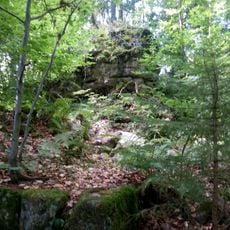
Burgruine Rotenburg, also called Burg Rotenberg, is a hilltop ruin on a steep 620.2 m rocky cone above the Kleine Wiese valley between Niedertegernau and Wieslet. An irregular oval ring ditch cut into the bedrock encircles the summit, with an outer rampart; the core castle covered about 50 by 25 m within an oval ring wall best preserved on the east side. A round bergfried about 9 m in diameter with walls some 3 m thick stood mid-way on the west side, and a 15 m stretch of walling survives in the south part.
The fortress was built between the 11th and 13th centuries as a stronghold for the Lords of Waldeck. It later came under the control of the Rötteln family through inheritance and gradually fell into ruin over subsequent centuries.
The name Rotenberg comes from the Rötteln family: Dietrich IV divided the estate with his brother Konrad in the mid-13th century and called himself after the Rotenberg. The castle is documented in 1259, 1270 and 1283 as the setting of a donation, and the Rotenberg line died out with Dietrich V around 1280.
The ruin sits on a steep, rocky hill cone at 620.2 m above sea level in the Kleine Wiese valley; it is reached on foot from Wieslet or Niedertegernau. The core castle is ringed by an irregular oval ditch cut into the bedrock, with a rampart in front of it, so expect rough, pathless ground. Only low masonry remains, including a 15 m stretch of wall in the southern part.
Pottery fragments found during excavations suggest an older predecessor fortress existed here in the 11th century. This discovery indicates the site was occupied longer than the visible medieval remains would suggest.
The community of curious travelers
AroundUs brings together thousands of curated places, local tips, and hidden gems, enriched daily by 92,893 contributors worldwide.