Burgruine Wohlenstein, Medieval castle ruin in Bilderlahe, Germany.
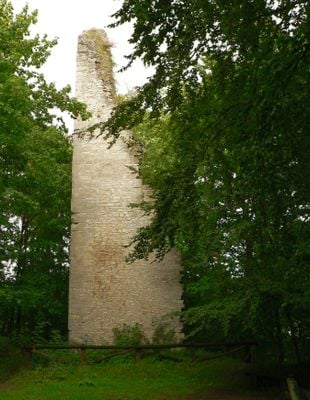
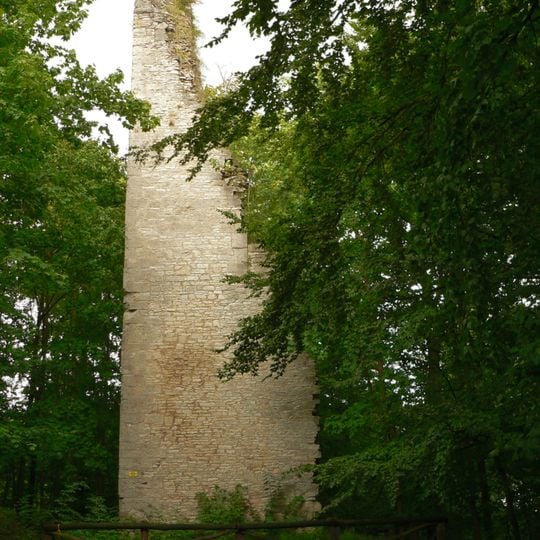
Burgruine Wohlenstein is the ruin of a small hilltop castle on the 253 m high Wohlenstein, a conical spur of the Heber above Bilderlahe. Only three wall sides of the bergfried remain, now 18 m high after once reaching 24 m, built of light gray and tan masonry blocks with walls almost 3 m thick and a jagged, broken top edge. The oval castle plateau measured 45 × 15 m and was divided into two areas; of the outer double ditch and rampart system, the outer wall and a moat over 10 m deep survive.
The castle was founded in 1295 and served as a power base for the Woldenstein family to control local trade networks. In 1519, Duke Erich of Calenberg-Göttingen destroyed it, which marked the end of its strategic importance.
The name Wohlenstein derives from the Wohldenberger family, who built the castle in 1295; the variant Woldenstein appears in older records. The site is also depicted on the gravestone of Bishop Henry III of Hildesheim, who acquired it in 1357, showing the castle around 1363. A 1591 map by Johannes Krabbe shows the castle as it stood in 1520 during the Hildesheim Diocesan Feud.
The site sits in a landscape with gentle hillsides and is easily reached on foot. Visitors should wear sturdy shoes since the ground is uneven and the ruins remain open to explore at any time.
Two depictions of the castle survive: the tomb slab of Bishop Heinrich III of Hildesheim, who bought it in 1357, shows it around 1363, and a 1591 map by Johannes Krabbe shows it in 1520 during the Hildesheim Diocesan Feud. The keep once stood 24 m tall; 18 m remain, with walls almost 3 m thick.
The community of curious travelers
AroundUs brings together thousands of curated places, local tips, and hidden gems, enriched daily by 92,754 contributors worldwide.