Burg Hohenwaldeck, Medieval castle ruins near Schliersee, Germany
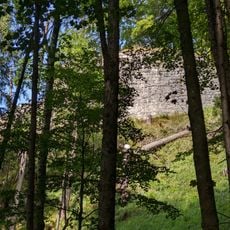
Burg Hohenwaldeck is a ruined hilltop castle on a rocky spur above the Schliersee, 209 metres above the lake at 986 metres elevation. Its surviving south and east walls of the front tower stand about six metres high, built with large bossed ashlar blocks. Around the plateau, sections of the limestone perimeter wall, made of blocks and rubble, reach up to eight metres and have no window openings.
The Lords of Waldeck, first documented in the mid-11th century as ministeriales of the Bishopric of Freising, began building Hohenwaldeck around the end of the 13th century. In 1312 Arnold von Waldeck destroyed the bishop's castle at Miesbach, and Freising had to renounce overlordship. The line died out in 1483; a rockfall in 1480 had already made the castle uninhabitable.
The name Hohenwaldeck comes from the Lords of Waldeck, whose original seat, Burgstall Altenwaldeck, survives south of Bad Aibling. Philipp Apian wrote in 1568 of a "ruin of an ancient castle called Waldegk", and Wiguläus Hundt took the rubble for pre-medieval pagan masonry in 1585. Information boards at the site were updated during the 2023–2024 restoration.
When visiting, note that the ruin sits on a ridge with steep access in places. Sturdy hiking boots and weather-resistant clothing are advised, as conditions at this elevation can change quickly.
The surviving tower stump still stands about six metres high on its south and east sides; its north and west walls are entirely gone. Its large bossed stone blocks were long misdated to Roman times, an error repeated on site information boards until they were updated during the 2023–2024 restoration.
The community of curious travelers
AroundUs brings together thousands of curated places, local tips, and hidden gems, enriched daily by 93,802 contributors worldwide.