Burg Hünenknüfer, Medieval castle ruins in Fröndenberg, Germany.
Burg Hünenknüfer, also called Hünenknüfel, was a hilltop castle in the Bentrop district of Fröndenberg. Today only a tower mound about 45 metres in diameter remains, and on the north side a section of a double wall-and-ditch system is still visible. In the 19th century three ditches were recorded, the outermost 3 metres deep and 6 metres wide, the middle 8 metres deep and 12 metres wide, and the inner 6 metres deep and 8 metres wide, with two ramparts between them.
No written sources can be securely tied to Burg Hünenknüfer. It may be linked to the nobleman Antonius von Scheda, mentioned in 1289, but a connection to the founding of nearby Kloster Scheda in Wickede is more likely: in 1143 Wiltrud von Rüdenhausen and her son Rathard converted a castle into a Premonstratensian monastery.
Local legend holds that a 1 km underground passage ran north from the castle to Kloster Scheda in Wickede, and a tale tells of a ghostly wagon at the site. The castle is also called Hünenknüfel. No written source can be securely tied to the castle; a link to the noble Antonius von Scheda, mentioned in 1289, is possible but uncertain.
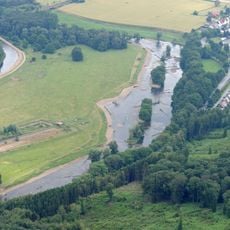
The site lies on a high slope above the broad Ruhr valley in the Bentrop district of Fröndenberg. The visible remains are a tower mound about 45 m across, with a section of the double wall-and-ditch system surviving to the north. Approach on foot through the surrounding countryside; the mound and ramparts are best picked out from the north side.
In the 19th century three ditches could still be traced: the outer one 3 m deep and 6 m wide, the middle 8 m deep and 12 m wide, the inner 6 m deep and 8 m wide, with two ramparts between them. A modern pavilion then stood on the summit of the mound.
The community of curious travelers
AroundUs brings together thousands of curated places, local tips, and hidden gems, enriched daily by 93,975 contributors worldwide.