Burg Jagsthausen, Medieval castle in Jagsthausen, Germany
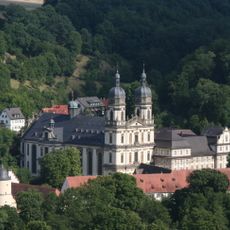
Burg Jagsthausen is a medieval hilltop castle with multiple structures including a palace with knights' hall, a ladies' house, a keep, and a service building with tall corner towers. The different parts are arranged around an inner courtyard in a defensive layout typical of such fortifications.
The castle's medieval origins trace to the Lords of Husen, and it is one of the ancestral seats of the Berlichingen family. It was rebuilt and expanded several times, most extensively between 1876 and 1878 by August Beyer, the master builder of Ulm Minster. Since 1950 it has served as the venue for the Jagsthausen castle festival and has been marketed as the Götzenburg.
Since 1950 the castle has hosted the Burgfestspiele Jagsthausen open-air theatre, and it has been marketed as the Götzenburg after Goethe's drama. The historical Götz von Berlichingen spent only a few years of his childhood here and never owned the castle, which passed to an older brother.
The castle is reached on foot from Jagsthausen, which lies in the Jagst valley below; the grounds sit on a slope above the river. The museum occupies one of the corner towers, and the park with its 19th-century ruin architecture surrounds the castle. The building now operates as the Schlosshotel Götzenburg, so parts are given over to hotel use.
The museum preserves the original iron hands that belonged to the historical figure who made this castle known worldwide through Goethe's drama. These prosthetics are evidence of an extraordinary life story and rank among the most remarkable objects in the collection.
The community of curious travelers
AroundUs brings together thousands of curated places, local tips, and hidden gems, enriched daily by 94,086 contributors worldwide.