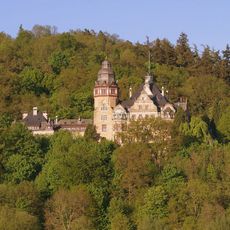
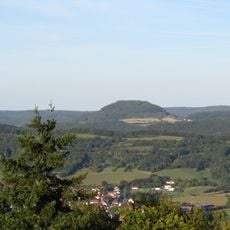
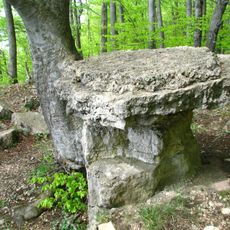
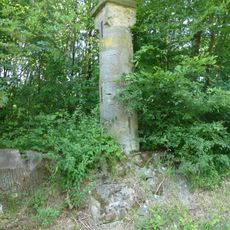
Burgruine Greifenstein, Medieval castle ruins in Geismar, Germany
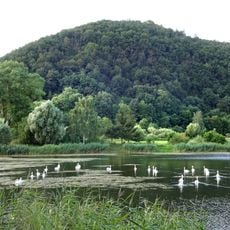
Burgruine Greifenstein is the ruin of a hilltop castle on the 442.5 m Schloßberg near Großtöpfer in the Eichsfeld district. Built of plain sandstone ashlar without decorative detail, it preserves a 5 m high stump of a round keep 10 m in diameter, remains of a vaulted cellar, and traces of ramparts and ditches.
Greifenstein was first documented in 1397, when citizens of Erfurt, Mühlhausen and Nordhausen, led by Duke Otto of Braunschweig, stormed and destroyed it for harbouring robber knights. Rebuilt, it passed to the Archbishop of Mainz and was pawned in 1461 to Duke Wilhelm of Saxony, then held by the Bültzingslöwen family until 1539. After border disputes between Mainz and Hesse-Kassel ended in 1583 it lost its strategic role and decayed, though a Mainz bailiff still sat there in 1661.
The name Greifenstein passed to the Mainz administrative office formed around the castle, whose district included Kella, Pfaffschwende, Rüstungen, Sickerode, Dieterode, Wiesenfeld and Hessel. A map of around 1590 shows a gallows between the castle and Pfaffschwende, where the office's high court held sessions, possibly at the castle itself.
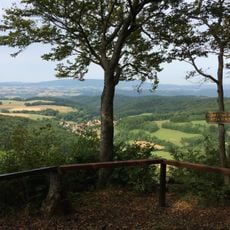
Visitors should wear sturdy shoes since the site includes stairs and uneven ground throughout the exploration areas. The best time to visit is during dry weather to safely navigate the different levels and viewpoints.
The castle was first recorded in 1397, when citizens of Erfurt, Mühlhausen and Nordhausen stormed and destroyed it under Duke Otto of Braunschweig because of its owners' raubritter conduct. Rebuilt afterwards, it passed to the Archbishop of Mainz, who made it the seat of the Amt Greifenstein.
The community of curious travelers
AroundUs brings together thousands of curated places, local tips, and hidden gems, enriched daily by 93,524 contributors worldwide.