Schloss Wolfsbrunnen, Neo-Renaissance castle in Schwebda, Germany
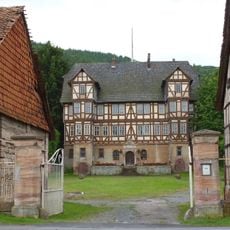
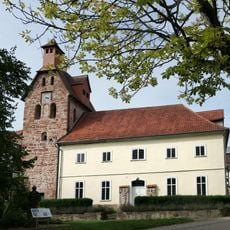
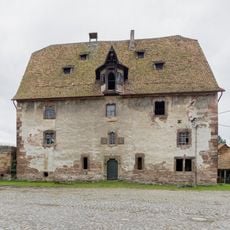
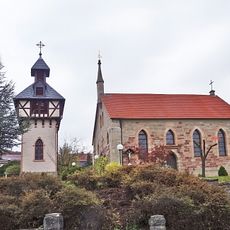
Schloss Wolfsbrunnen is a Neo-Renaissance castle built between 1904 and 1907 for Alexander von Keudell, about 800 m north-northeast of Schwebda in the Meinhard forest. Its U-shaped three-winged section with gatehouse and cour d'honneur adjoins a five-storey tower with a timber-framed upper floor and a baroque stepped hood, next to the nearly square three-storey main building with a stepped pyramid roof and corner turrets.
Alexander von Keudell, Prussian chamberlain and district administrator of Eschwege, had the castle built between 1904 and 1907. It was partly a gift from Kassel industrialist Oscar Henschel, whose daughter Louise Keudell had married. The couple moved in on 27 June 1907. From 1945 to 1947 the UNRRA ran a children's center here for orphaned Jewish children.
The name Wolfsbrunnen comes from an old spring called the Wolfsborn, which is tucked inside the courtyard and still visible today. The architect who designed the building chose to keep this water source intact when the residence was constructed.
The castle is clearly visible from Schwebda and can be reached on foot from the village. Anyone planning to stay or eat at the restaurant should book ahead, as the venue is also used for private events.
From 1982 to 1985 the castle housed a Rajneesh community of about 80 adults and 30 children, who ran a publishing house with printing press, a carpentry workshop and a car repair shop there.
The community of curious travelers
AroundUs brings together thousands of curated places, local tips, and hidden gems, enriched daily by 93,860 contributors worldwide.