Busdorfkirche, Catholic church in Paderborn, Germany
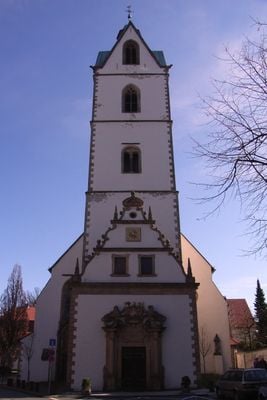
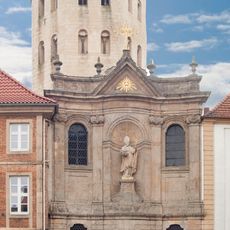
Busdorfkirche is a Romanesque and Gothic church in Paderborn whose west tower rises in three sections: a 12th-century lower part, a Gothic third storey and gable, and a roof form rebuilt in 1629. The tower is white with grey stone corner quoins, a pointed-arch window above a round-arched window, and a gabled facade with a golden-handed clock. The three-aisled hall church has a west portal from around 1400 and a Baroque porch of 1667 by Ambrosius von Oelde.
Bishop Meinwerk founded the Busdorf collegiate church and had it consecrated in 1036 to Saints Peter and Andrew, in the presence of Emperor Conrad II. Around 1033 he had sent Abbot Wino of Helmarshausen to Jerusalem to measure the Church of the Holy Sepulchre, and the first church was built as an octagonal copy of it. A fire destroyed the church in 1289; the present three-aisled hall church was rebuilt around 1300, and the west tower received its current form in 1629.
The church serves as an active parish space where residents gather for worship and community events throughout the year. Its continued religious use keeps the building integrated into the daily rhythm of local life.
Visitors can enter the church during regular opening hours to view the architecture and interior from up close. Visiting early in the day helps you experience the space with fewer crowds around.
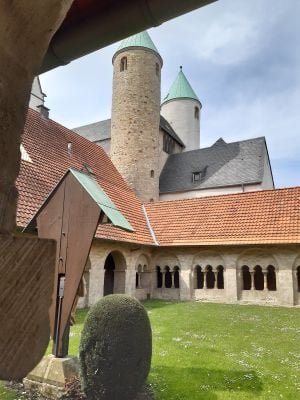
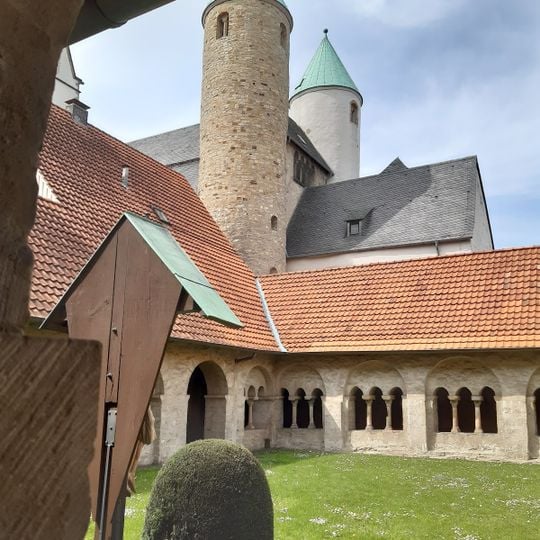
Grooves on the column shafts and the south portal of the Romanesque cloister, the Pürting, are interpreted as traces of a medieval custom of sharpening swords on the stone.
The community of curious travelers
AroundUs brings together thousands of curated places, local tips, and hidden gems, enriched daily by 92,874 contributors worldwide.