Spielbank Baden-Baden, Casino in Baden-Baden, Germany
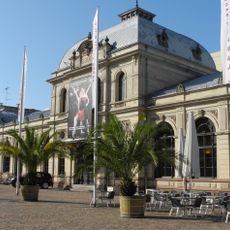
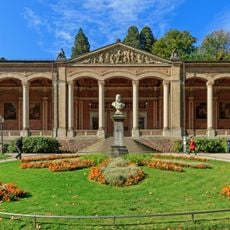
Spielbank Baden-Baden occupies the central block of the Kurhaus, whose portico of eight Corinthian columns carries a red-and-white griffin frieze. Gaming tables stand in the middle section, with the Weinbrennersaal behind the colonnade serving as a gaming hall; the left wing incorporates the 1766 Promenade House, while a theatre occupied the right wing.
Gambling was first licensed in Baden-Baden in 1801 in hotels; from 1808 Friedrich Weinbrenner rebuilt the former Jesuit college, where a casino opened on 16 June 1812. In 1824 it moved into the new Conversationshaus (Kurhaus), whose central hall became the gaming room. From 1824 to 1838 Antoine Chabert held the sole concession.
The name Spielbank simply means gaming house. In the 18th century, innkeepers along the road to the Geroldsauer waterfall and Lichtenthal monastery were allowed to keep a side room for games of chance, supervised by a margravial gaming commission from 1748. Summer guests played rouge et noir, écarté and whist.
The casino occupies the central section of the Kurhaus, entered through the portico of eight Corinthian columns topped by a red-and-white griffin frieze. Gaming takes place in the Weinbrennersaal behind that portico. The building stands on the left bank of the Oos, a short walk from the town centre.
The casino's licence history is recorded in the sources: from 1812 two French officers held the concession, in 1815 the Berlin merchant S. Oppenheimer took it for 15 years, and from 1824 to 1838 Antoine Chabert was the sole leaseholder. The gaming tax funded the spa fund, which paid for canalising the Oos and building bridges.
The community of curious travelers
AroundUs brings together thousands of curated places, local tips, and hidden gems, enriched daily by 93,878 contributors worldwide.