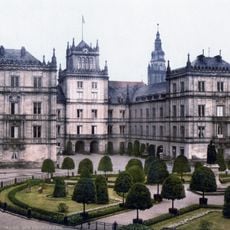
Schlossplatz, Square and architectural heritage monument in Coburg, Germany.
Schlossplatz is a wide square laid out from 1825 to 1849 as the forecourt of Schloss Ehrenburg in central Coburg, with Karl Friedrich Schinkel and Peter Joseph Lenné involved in its design. The south side is closed by the castle's neo-Gothic north wing, the north by the Landestheater of 1837–1840, and the east by arcades of 1843 by Hermann Nicolai, which lead up to the Hofgarten. In the middle stands the monument to Duke Ernst I, cast from two melted-down French cannon and unveiled on 17 August 1849, ringed by a flower garden whose axes are turned 45° to those of the castle.
Schlossplatz was laid out from 1825 under Duke Ernst I, when the eastern houses of Grafengasse were demolished; the castle's old service buildings to the north followed in 1835. Its present form as a representative square was completed by 1849 in historicist and Neoclassical style, with Karl Friedrich Schinkel and Peter Joseph Lenné involved.
Until World War I, the III Battalion of the 6th Thuringian Infantry Regiment No. 95 paraded here, with a military band playing on Sunday afternoons. In the 1920s the square served as a rally ground for demonstrators, as on Coburg's Bloody Saturday. Today it hosts open-air concerts and events, and cars may park here on evenings with theatre performances.
The arcades on the east side have stairs leading up to the Hofgarten, which sits above the square. In the evening, parking is allowed on the square during performances at the Landestheater. The square also serves as a venue for open-air concerts.
The Ernst I monument in the square's centre was cast in 1849 from two melted-down French cannons; his son Ernst II commissioned it from Munich sculptor Ludwig von Schwanthaler, and the pedestal was designed by court architect Carl Friedrich Wilhelm Streib.
The community of curious travelers
AroundUs brings together thousands of curated places, local tips, and hidden gems, enriched daily by 92,718 contributors worldwide.