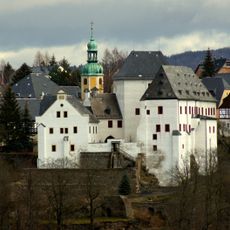
Schloss Wolkenstein, Medieval castle in Wolkenstein, Germany.
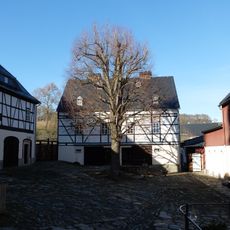
Schloss Wolkenstein is a high medieval castle on a rocky spur about 80 metres above the Zschopau river in Wolkenstein, Saxony. Its oldest surviving parts are the 14th-century residential tower and the kitchen house in the northeast; the south and north wings with the gatehouse were added in the 16th century.
Wolkenstein Castle was first documented in the 13th century and served as a ministerial seat for the Lords of Waldenburg in the Pleißenland, protecting a trade route to Bohemia. From 1378 it was their main residence until the line died out in 1473, when the fief passed to the Wettins. Around 1500 Henry the Pious had it enlarged as a hunting lodge, and about 1550 his son Augustus converted it into a Renaissance residence. Damage during the Thirty Years' War and later neglect caused parts to decay.
The castle's name comes from the Lords of Waldenburg, who held Wolkenstein from 1378; the nearby town took the name. Since 1963 part of the west wing has housed a local history museum, and today the restored Fürstensaal in the south wing is used for events while the town registry office holds weddings in a historic room.
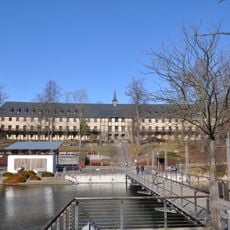
The castle sits on a rock spur about 80 metres above the Zschopau, which loops around it near the mouth of the Preßnitz. The Museum Schloss Wolkenstein occupies part of the building, with a restaurant on the ground floor and the town's wedding room in a historic hall. The Fürstensaal in the south wing is used for events.
The oldest surviving parts are the 14th-century residential tower and the kitchen house in the northeast; the main building is dated to the 15th century, and the south and north wings with the gatehouse were added in the 16th century. The complex was already called slosz Wolkenstein in 1372, although its fortified character dominates.
The community of curious travelers
AroundUs brings together thousands of curated places, local tips, and hidden gems, enriched daily by 92,808 contributors worldwide.