Köpferbrunnenanlage, Water well complex in Köpfertal forest area, Heilbronn, Germany
The Köpferbrunnenanlage is a spring complex featuring a stone chapel, music pavilion, and water source linked by forest paths and stone bridges in eastern Heilbronn. The site sits nestled within wooded hills and connects different areas through carefully laid routes.
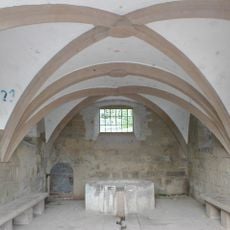
The Heilbronn Verschönerungsverein, founded in 1863, decided in 1877 to restore the decayed shelter at the spring once built by the so-called Waldbrüder. The chapel or hermit's cell was rebuilt in neo-Gothic style in 1880, with a hermit's head above the portal; stone bridges followed in 1898 and 1904, and a music pavilion was added.
The name Köpfertal probably comes from the mountain tops (Bergköpfe) between which the Köpferbach rises, not from executions. The site nevertheless served in 1814 as execution place for the robber-murderer Doderer, and legend says the Heilbronn nobleman Veit Imlin was beheaded here. The chapel was reshaped in 1880 in neo-Gothic style and its portal crowned with a hermit's head.
The complex lies in the wooded Köpfertal east of Heilbronn; the Uferweg runs north from it to the Trappenseeschlösschen, and the upper Köpfertal lies to the south. Stone bridges of 1898 and 1904 carry the paths over the Köpferbach. The stream rises about 300 metres south of the fountain in the Steinkohlenklinge.
The fountain in front of the hermitage chapel carries a verse from Virgil's Georgics (II, 493): Fortunatus ille Deos qui novit agrestes, "happy is he who knows the rural gods". The Heilbronn Beautification Association, founded in 1863, chose the line when it rebuilt the spring house from 1877 onward.
The community of curious travelers
AroundUs brings together thousands of curated places, local tips, and hidden gems, enriched daily by 92,893 contributors worldwide.